


Why Speed-to-Learning Matters More Than Speed-to-Market
Key Highlights
- Launching quickly does not guarantee success. A strong product development strategy validates critical assumptions before significant investment.
- Learning velocity improves decisions. The faster teams turn uncertainty into useful evidence, the sooner they can determine what is worth building.
- Small experiments reduce risk. Prototypes, pilots, and customer feedback can reveal problems before they become expensive.
- Data and feedback should drive priorities. Meaningful progress depends on measurable outcomes, not simply completed features.
- AI makes experimentation faster, but not automatically better. Clear objectives and business judgment remain essential.
Speed-to-market has long been a priority for businesses developing new products and digital solutions. Launching before competitors can create an advantage, particularly when customer expectations and technology are changing quickly.
But organizations can meet a release deadline and still discover that customers do not value the functionality they prioritized or that the solution fails to address the underlying business problem.
That is why speed-to-learning deserves a more prominent place in product development strategy. The ability to test assumptions, gather evidence, and adjust direction early can be more valuable than reaching the market first.
Speed-to-market determines how quickly an organization delivers. Speed-to-learning helps determine whether what it delivers is worth the investment.

Why Speed-to-Market Is No Longer Enough
Speed-to-market still matters. Delays can mean missed opportunities, lost revenue, or stronger competition. However, speed becomes a liability when organizations move forward without evidence that they are solving the right problem.
This risk is well documented. A 2026 CB Insights study found that 43% of failed startups with identifiable reasons for closing struggled with product-market fit. While the research focuses on startups, it reinforces a broader lesson: building quickly offers little advantage if you’re solving the wrong problem.
AI-assisted development tools, cloud platforms, and reusable software components are making it easier to create prototypes and deliver functionality. But the ability to build something quickly does not establish that it is worth building.
Consider a hypothetical company developing a customer portal. Leadership assumes customers want more self-service features. After launch, customers continue contacting support because their real frustration was difficulty finding accurate information.
The company delivered the requested functionality without solving the underlying problem. Earlier customer research could have changed the investment.
The cost of learning too late extends beyond rework. It includes the resources and opportunities committed to solving the wrong problem.
Make Learning Velocity Part of Your Product Development Strategy
Learning velocity is the speed at which an organization turns uncertainty into information that improves decisions.
It is not measured simply by the number of experiments completed or interviews conducted. Learning creates value when it changes what an organization understands and what happens next.
Identify What You Need to Learn First
Most initiatives begin with assumptions about customer needs, adoption, technical feasibility, and business value. Before committing significant resources, leaders should examine five areas:
- Customer need: Are we solving a problem customers consider important?
- Adoption: Will customers or employees use the solution in their actual workflows?
- Technical feasibility: Can it work reliably with existing systems and data?
- Business value: Will the expected improvement justify the investment?
- Organizational readiness: Can the business support and sustain the solution?
The priority should be assumptions that are both uncertain and consequential.
For example, if a product depends on integrating with a legacy system, testing that integration may be more important initially than refining the interface. If customer demand is uncertain, validating the need should come before building the solution.
Separate Learning Milestones From Delivery Milestones
Traditional roadmaps emphasize completed requirements, developed features, and scheduled releases. These milestones help manage delivery but do not necessarily demonstrate business progress.
A delivery milestone might be completing a customer self-service workflow. A corresponding learning milestone would be determining whether customers can complete a priority task without contacting support.
The first measures whether functionality was delivered. The second establishes whether it solves the intended problem.
Organizations should track both. Delivery milestones demonstrate execution, while learning milestones provide evidence for investment decisions.
How Can Rapid Experimentation Reduce Product Risk?
Rapid experimentation tests important assumptions before they become expensive commitments.
An experiment does not require a complete product. Customer interviews, prototypes, usability tests, technical proofs of concept, and limited pilots can all provide useful evidence.
The key is choosing the simplest credible way to answer the most consequential question.
The Speed-to-Learning Framework
Different uncertainties require different forms of validation. A technical proof of concept may establish feasibility without proving customer demand. Similarly, positive prototype feedback does not guarantee adoption.
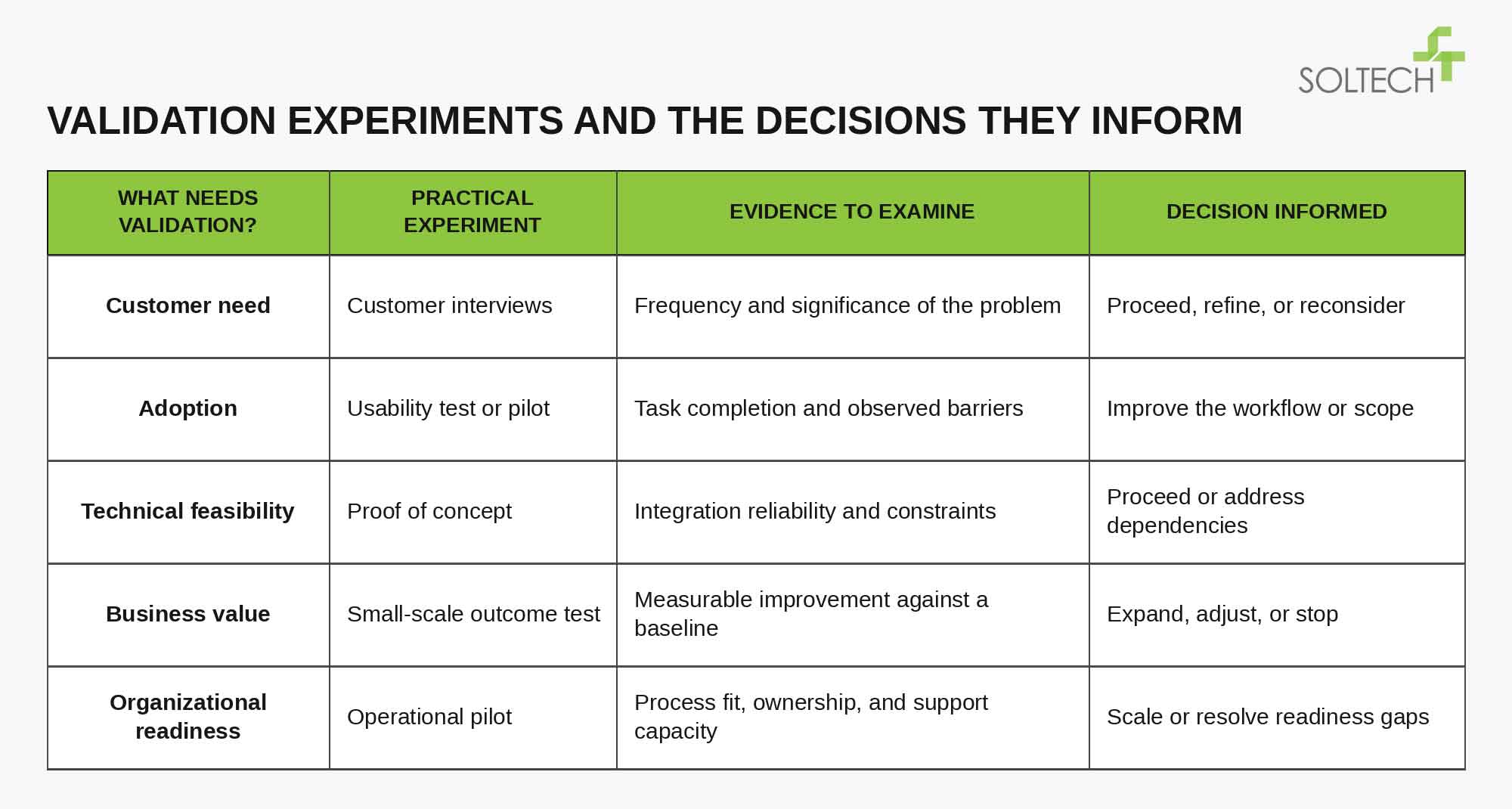
Before experimenting, teams should define what evidence would justify proceeding, refining the approach, or stopping.
Stopping an initiative can be a successful outcome when evidence shows that its expected value does not justify further investment.
The purpose of experimentation is not to prove the original idea was right. It is to improve the decision before the organization becomes heavily committed.
Feedback Loops Should Shape the Product, Not Just Measure It
Organizations often collect customer comments, usage analytics, and stakeholder opinions without establishing how those inputs should influence product priorities.
An effective feedback loop connects what users experience to decisions about what happens next.
Combine Customer Feedback With Behavioral Data
Customer interviews help explain why people respond to a product in certain ways. Behavioral data shows what they actually do. Neither provides the full picture independently.
For example, analytics might reveal that users regularly abandon a workflow. Conversations with those users can help determine whether the cause is confusing design, missing information, or a process that does not meet their needs.
Together, these insights support more targeted improvements.
Turn Feedback Into Decisions
Feedback should inform discovery, design, testing, and early adoption, not just post-launch reviews.
That requires clear ownership and a process for prioritizing findings. Not every customer request should become a feature. Leaders should consider how frequently an issue occurs, its business impact, and whether addressing it supports the product’s objectives.
The goal is a product that evolves based on evidence rather than accumulating requests.
Data-Driven Decisions Require More Than Dashboards
More data does not automatically produce better decisions. Organizations can invest in analytics and reporting while still struggling to determine what matters.
The starting point should be the business decision, followed by the evidence needed to support it.
Measure Outcomes, Not Just Activity
Website visits, feature usage, and release frequency can be useful indicators, but they need to connect to meaningful outcomes.
For customer-facing products, that might mean successful task completion, retention, or reduced support needs. For internal systems, it could mean shorter processing times, fewer manual steps, or improved accuracy.
For example, measuring how many tasks have been automated shows activity. Measuring whether automation reduces processing time and errors shows whether it delivers business value.
Establishing a baseline before introducing changes makes it easier to evaluate results.
Address Data Readiness Early
Reliable learning depends on reliable information. Incomplete, inconsistent, or inaccessible data can lead teams toward incorrect conclusions.
A data strategy consultant may be valuable when an initiative depends on multiple systems or requires new analytics capabilities.
The objective is not to build sophisticated infrastructure before experimenting. It is to establish whether the organization has enough trustworthy information to answer its most important questions.
What Changes When AI Makes Product Development Faster?
AI can accelerate research, prototyping, coding, and analysis, shortening the time between identifying a problem and testing a solution. But it also makes it easier to produce more functionality without establishing whether it creates value.
Google Cloud’s 2025 DORA research, based on nearly 5,000 technology professionals and more than 100 hours of qualitative research, found that AI can amplify an organization’s existing strengths and weaknesses. The findings emphasize the importance of clear workflows, user-centered practices, and effective feedback loops rather than AI adoption alone.
For example, AI-assisted development may help teams create several workflow prototypes quickly. But faster prototyping only creates value if those alternatives are tested against real user needs.
AI can shorten the time required to build and test a solution, but it cannot eliminate the need to validate customer demand, business value, or operational readiness. Organizations that use AI to accelerate experimentation, not simply production, are better positioned to turn technical speed into meaningful progress.
What Should You Expect From a Product Development Partner?
A technology partner should help an organization make better investment decisions, not simply execute a predetermined feature list.
Whether working with a product engineering firm or evaluating broader technology and IT consulting services, leaders should expect meaningful discussion about the business problem, the assumptions behind the proposed solution, and the evidence needed before larger commitments.
Look for a partner that:
- Starts with the business problem rather than immediately recommending technology.
- Challenges assumptions and explores alternatives to the proposed solution.
- Uses evidence from research, prototypes, or pilots to guide recommendations.
- Explains tradeoffs involving cost, complexity, feasibility, and risk.
- Adapts the roadmap as new information becomes available.
Before engaging a development partner, ask: What assumptions would you recommend testing before we commit to building this solution?
The answer can reveal whether the partner is focused solely on delivery or on helping the organization make better investment decisions.
The Competitive Advantage Is Learning Before You Overcommit
Speed-to-market remains important when timing affects revenue, customer relationships, or competitive positioning. But the fastest launch is not always the strongest business outcome.
Organizations that learn early can make more informed decisions about where to invest, which assumptions require further testing, and when to change direction. They may discover that an idea deserves greater investment, that a smaller solution will deliver the same value, or that an initiative should not proceed.
For business leaders, the practical next step is to examine the next significant product investment and ask: What do we still need to learn before we commit?
The answer may change the scope, roadmap, or solution itself. That is why learning deserves a place alongside speed in any product development strategy.
Frequently Asked Questions About Speed-to-Learning
How Do You Know When a Product Has Been Validated Enough to Launch?
Look for credible evidence that the product addresses a meaningful need, critical workflows function reliably, and remaining risks are acceptable. The level of validation should reflect the investment and consequences of failure.
How Much Should a Company Budget for Product Discovery and Experimentation?
There is no universal percentage. The appropriate investment depends on uncertainty, complexity, potential business value, and the cost of making the wrong decision. Prioritize experiments that can influence significant investment decisions.
Who Should Own Learning and Experimentation Decisions?
Business and product leadership should own investment decisions, with input from technology, design, data, and operational teams. Clear accountability ensures findings lead to action.
Can Speed-to-Learning Work in Highly Regulated Industries?
Yes, with appropriate controls. Approved test environments, synthetic data, controlled pilots, and documented reviews can reduce uncertainty without bypassing regulatory, privacy, or safety requirements.

Ann Mooney
Director of Business Development Ann Mooney is the Director of Business Development at SOLTECH, and has over 30 years in Sales and Account Management in the Technology, Telecommunications, and Medical Industries. Ann’s key specialties are building long-term business relationships, results-driven sales, and account management.
Ann joined SOLTECH in 2016, she works directly with SOLTECH’s clients to help find them the best technology solutions for their business. Ann utilizes her strategic leadership and proactive problem-solving skills to continually grow SOLTECH’s business and ensure excellent customer service.
With her years of experience in the technology industry, Ann likes to share her expertise to educate her audience on the enhancement of workplace productivity and growth through software solutions in her articles. Her insights offer advice on important considerations for creating custom software, including initial steps, development costs, and timelines, as well as the advantages of collaborating with a skilled software development team.
Recent Posts
Search