

The New Buying Criteria for IT Solutions and Technology Companies
Choosing among IT solutions and technology companies has become more complex because technology decisions now shape far more than IT infrastructure. They influence growth, customer experience, operational efficiency, and competitive strategy. As a result, executives are evaluating technology partners differently than they did even a few years ago. Technical expertise is still essential, but the firms earning long-term partnerships are the ones that help organizations navigate uncertainty, make better business decisions, and adapt as priorities evolve.
What Has Changed About Buying Technology Services?
The way organizations buy technology services has fundamentally changed. Not because technology has become more complicated, but because it has become more important.
There was a time when many technology investments lived almost entirely within the IT department. Success was measured by whether a system was implemented correctly, infrastructure remained stable, or an application performed as expected. While those outcomes still matter, technology now plays a much larger role in how organizations operate and compete.
A modernization initiative may support an acquisition strategy. A data platform may enable better executive decision-making. An AI initiative may reshape customer service or internal operations. Technology has become intertwined with business strategy, which means the buying process has changed alongside it.
Technology Decisions Have Become Business Decisions
As technology has become more central to the business, more people have become involved in deciding where to invest. A project that once required approval from IT leadership may now include the CEO, CFO, operations leaders, department heads, and even board members.
Each stakeholder brings different priorities. Finance may focus on Return On Investment (ROI) and the financial case for moving forward. Operations may prioritize efficiency and scalability. Business leaders often care most about speed, customer experience, or competitive advantage, while technology leaders may be thinking about enterprise architecture, security, integration, and how a new solution fits into the broader technology environment.
That broader perspective naturally changes how providers are evaluated. Technical expertise still matters, but it is no longer enough to answer every question executives have before making a significant investment.
Buying Confidence Has Become as Important as Technical Confidence
One pattern I’ve noticed in conversations with business leaders is that they rarely question whether an established technology firm can build software or implement a platform. Those capabilities are expected.
What creates hesitation is everything surrounding the technical work:
- How will this partner respond when priorities change?
- Will they communicate openly when challenges arise?
- Do they understand how this project supports the business?
- Are they focused only on delivering technical requirements?
This is part of why vendor due diligence has become more important. Whether a company is running a formal RFP process or evaluating a smaller group of potential partners, the goal isn’t simply to verify capabilities. Leaders are trying to determine how a firm thinks, collaborates, manages risk, and behaves when an engagement becomes more complicated than the initial scope suggests.
Executives aren’t simply buying technical capability anymore. They’re buying confidence that the right decisions will be made throughout the engagement.
Why Is Technical Expertise No Longer the Primary Differentiator?
Technical excellence remains a requirement. No organization wants to partner with a firm that lacks the engineering talent or experience to execute successfully.
The difference is that technical expertise has become the price of admission. Most established providers of IT and technology services have experienced engineers, proven delivery methodologies, and successful client engagements. Those capabilities help narrow the field, but they rarely determine the final decision.
The Hardest Problems Usually Aren’t Technical
Technology projects often begin with a technical challenge, but they rarely stay there. Business priorities shift. New stakeholders become involved. Budget assumptions change. Regulatory requirements emerge. Departments discover competing needs that weren’t visible at the beginning of the project. These moments typically determine whether an initiative succeeds.
The organizations I speak with rarely describe unsuccessful projects by saying the software didn’t function. More often, they talk about misaligned expectations, slow decision-making, poor communication, or a lack of flexibility when circumstances changed. Those are partnership challenges, not engineering challenges.
The Best Partners Understand Business Context
Strong tech solutions consulting starts well before recommending a solution. It begins by understanding why the initiative exists in the first place.
Is the organization trying to…
- Improve customer experience?
- Increase operational efficiency?
- Prepare for growth?
- Modernize a critical system?
- Handle systems integration following an acquisition?
The answer also looks different across industries. Healthcare leaders may prioritize compliance, patient data security, and interoperability. Manufacturers may be more concerned with operational resilience, connected systems, and supply chain visibility. Financial institutions often place greater emphasis on governance, security, and risk management, while professional services firms may prioritize collaboration, automation, and client experience.
Those differences matter because two businesses can pursue similar technology initiatives for very different reasons. The underlying business objective should influence the architecture, investment priorities, implementation approach, and definition of success. Without that context, it’s possible to build the right solution for the wrong problem.

What Do Executives Often Overlook When Evaluating Technology Partners?
One of the biggest shifts in technology buying is that leaders are becoming more aware of the risks they can’t easily see during the sales process.
Most firms can demonstrate technical expertise through case studies, certifications, client references, and a polished RFP response. Those are valuable indicators, but they don’t always reveal what the partnership will feel like once the project begins.
Delivery Is Only Part of the Relationship
Technology projects involve hundreds of decisions after the contract is signed. Requirements evolve. Timelines shift. New priorities emerge. Leaders need to make tradeoffs between budget, speed, functionality, and risk.
For larger initiatives, the original business case or digital transformation roadmap may provide direction, but it can’t anticipate every decision the business will face. The quality of the conversations that follow often has a greater impact on project outcomes than the original project plan.
A technology partner should help leaders make those decisions with confidence rather than simply wait for direction. That means understanding when to follow the roadmap, when to challenge an assumption, and when new information justifies changing course.
Ask How They Work, Not Just What They Build
During Vendor Due Diligence, many businesses spend significant time reviewing portfolios and technical capabilities but relatively little time understanding how a firm approaches collaboration. A strong proposal can tell you what a provider intends to deliver. It tells you much less about how that provider will behave when priorities compete or difficult decisions need to be made.
Questions like these often reveal more than another case study:
- How do you handle changing priorities?
- How do you communicate project risks?
- When stakeholders disagree, how do you facilitate decisions?
- How do you help clients evaluate competing priorities?
For certain investments, a Proof of Concept (PoC) can also be useful, particularly when the organization needs to validate an assumption before committing to a larger investment. But a PoC shouldn’t only prove that a technology works. Used thoughtfully, it can test whether the proposed approach solves the right problem, whether users see value in it, and whether the potential ROI justifies moving forward.
Those conversations and early validation efforts provide a clearer picture of both the solution and the partnership before the organization makes a larger commitment.
Why Adaptability Has Become a Competitive Advantage
Five years ago, many organizations believed successful technology projects were those that followed the original plan. Today, that assumption is becoming less realistic.
Business conditions change too quickly. New regulations emerge, market opportunities appear unexpectedly, AI capabilities continue evolving, and companies acquire competitors or enter new markets. Projects that last several months or longer are almost guaranteed to encounter new information.
Change Should Be Managed, Not Avoided
The strongest technology partnerships aren’t built around preventing change. They’re built around responding to change thoughtfully.
That requires clear communication, transparent decision-making, and an understanding of how adjustments affect timelines, budgets, and business outcomes. Flexibility isn’t about abandoning discipline. It’s about recognizing that successful delivery often depends on adapting without losing sight of the original objectives.
Why Communication Has Become a Strategic Capability
Communication is often discussed as a project management skill. Increasingly, it’s becoming a business capability.
Technology projects bring together executives, department leaders, technical teams, and outside partners, each with different priorities and perspectives. Keeping those groups aligned requires more than regular status meetings.
Alignment Creates Better Decisions
Good communication helps organizations make better decisions because everyone understands the same reality.
Leaders know which risks deserve attention. Project teams understand shifting priorities. Business stakeholders can evaluate tradeoffs before small issues become expensive problems.
That level of alignment becomes especially important when projects involve multiple vendors or several internal departments. The role of a technology partner is no longer just to execute work. It’s to help keep the entire initiative moving toward the same business outcome.
A Better Framework for Evaluating Technology Partners
Organizations evaluating technology and tech product companies often focus on technical demonstrations, pricing, and implementation timelines.
Those factors matter, but they don’t tell the whole story.
A stronger evaluation process also considers how a partner thinks, communicates, and collaborates throughout the engagement.
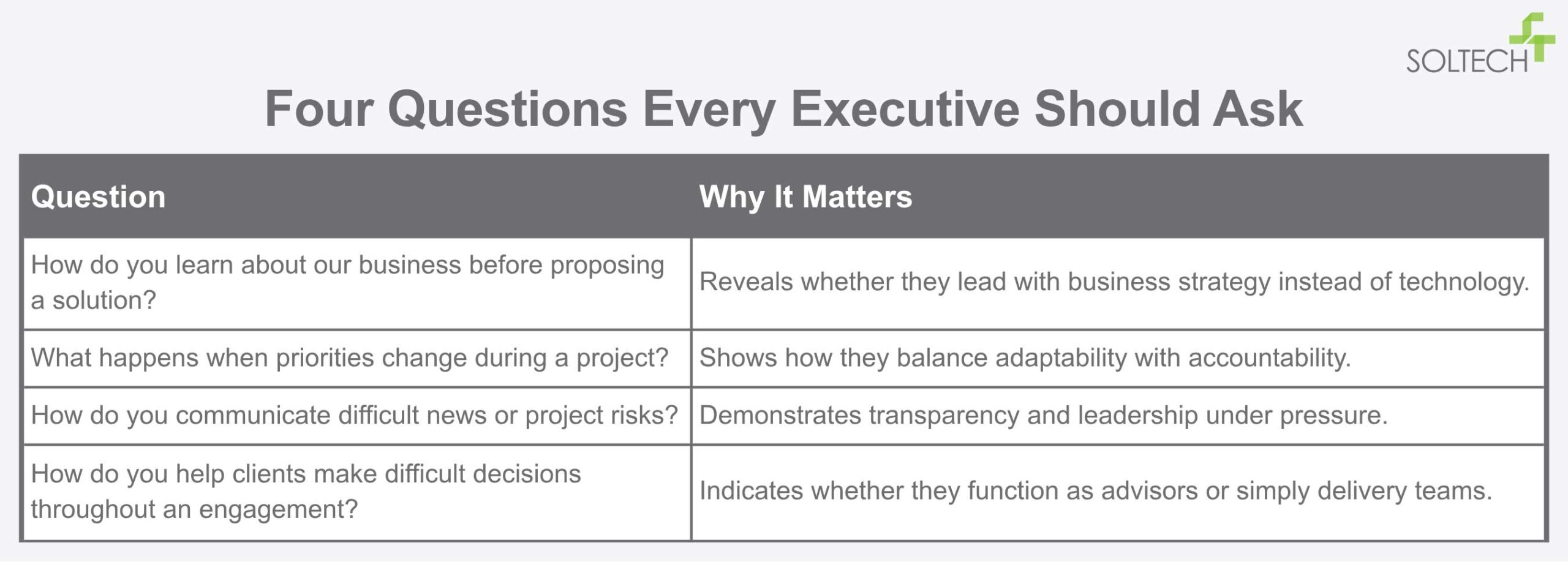
These questions help evaluate something that’s difficult to measure but often determines long-term success: the quality of the partnership itself.
Looking Ahead: Technology Buying Will Continue to Evolve
As technology becomes more integrated into every aspect of the business, buying decisions will continue to evolve alongside it.
Technical expertise will always be essential, but it is becoming less of a competitive differentiator because it is increasingly expected. What separates firms today is their ability to connect technology decisions to business strategy, navigate uncertainty, and build trust throughout the engagement.
The organizations that achieve the greatest value from technology investments won’t necessarily be those that select the most technically impressive provider. They’ll be the ones that choose partners capable of helping them make better decisions as their business continues to change.
For IT solutions and technology companies, that’s the new buying criteria.
FAQs
How do technology solutions improve business efficiency?
Technology solutions improve business efficiency by automating manual processes, connecting disconnected systems, improving access to data, and helping employees make faster, more informed decisions. The greatest value comes when technology investments support broader business goals rather than solving isolated technical problems.
What are the main types of IT services provided by organizations?
Common IT and technology services include custom software development, cloud migration, cybersecurity, managed IT services, systems integration, application modernization, infrastructure management, data analytics, and strategic consulting. The right mix depends on an organization’s goals, existing technology environment, and long-term strategy.
What should I consider when choosing an IT service provider?
Beyond technical expertise, evaluate how well a provider understands your business, communicates throughout the engagement, responds to changing priorities, and helps leadership make informed decisions. Those qualities often have a greater impact on long-term success than technical capabilities alone.
How do technical services vary across different industries?
While many technical capabilities remain consistent, the business priorities behind them differ significantly. Healthcare organizations prioritize compliance and patient data security, manufacturers focus on operational efficiency and connected systems, financial institutions emphasize security and risk management, while professional services firms often prioritize collaboration and client experience. Effective technology partners tailor their recommendations to those business realities rather than applying the same approach across every industry.

Austin Smith
VP of Strategy and Operations Austin Smith is the Vice President of Strategy and Operations at SOLTECH, where he helps shape the company’s strategic direction, optimize internal operations, and drive innovation through emerging technologies. Since joining SOLTECH in 2020, Austin has played a key role in enhancing business systems and reporting, leading people operations, and advancing the strategic use of artificial intelligence. He holds a Bachelor of Science in Business Administration with a concentration in Information Systems Management from Auburn University.
In his role, Austin oversees the systems and processes that support service delivery while working closely with organizations evaluating technology initiatives and digital transformation strategies. Through ongoing conversations with CEOs, founders, executives, and IT leaders, he gains firsthand insight into the challenges, priorities, and decision-making processes shaping today’s technology investments.
Drawing on these conversations, along with his experience in strategy, operations, and business development, Austin shares practical insights on how organizations evaluate technology partners, navigate evolving market trends, and make informed technology decisions. His articles help business leaders identify the right strategies, build stronger partnerships, and create long-term business value.
Recent Posts
Search