


Why Enterprises Need Fewer Vendors and More Strategic Technology Solutions
Organizations rarely set out to build a complicated technology ecosystem.
It usually happens one decision at a time. A new initiative requires a specialized partner. A business acquisition introduces another vendor. A growing company adopts new systems to support evolving needs. Individually, each decision makes sense.
Over time, however, many organizations find themselves managing an increasingly complex network of vendors, platforms, and priorities. What started as a series of smart decisions becomes difficult to coordinate, making it harder to move initiatives forward with confidence.
That’s one reason strategic technology solutions have become such an important conversation. The challenge isn’t simply finding another technology expert. It’s finding partners who can connect technology decisions to broader business goals.
Increasingly, business leaders aren’t looking for more vendors. They’re looking for strategic problem solvers.

Why Is Vendor Sprawl Becoming a Business Challenge?
Vendor sprawl is often viewed as an operational issue, but in many organizations, it’s really a leadership challenge. That aligns with what we’re seeing across the market. Gartner has noted that organizations are increasingly evaluating vendor consolidation as a way to reduce complexity, improve governance, and simplify operations rather than simply lower costs.
As technology becomes more specialized, organizations naturally rely on different partners for different capabilities. That expertise is valuable and, in many cases, necessary. The challenge isn’t having experts. It’s making sure those experts are working toward the same objective.
Coordination Becomes More Difficult Than Execution
One pattern I’ve noticed is that initiatives rarely lose momentum because teams lack technical capability. More often, progress slows because leadership is left coordinating multiple partners with different priorities, timelines, and definitions of success. Eventually, the work of managing vendors begins competing with the work of moving the business forward.
Why Doesn’t More Expertise Always Lead to Better Results?
Organizations often assume that adding expertise will reduce risk.
In reality, every new partner introduces another relationship to manage, another perspective to consider, and another handoff between teams. As complexity increases, accountability can become fragmented.
Alignment Is More Valuable Than More Vendors
One partner owns one piece of the initiative while another manages a different workstream. Each delivers quality work within its own scope, but no one is responsible for ensuring those individual efforts support the organization’s broader strategy.
That’s an important distinction.
The challenge isn’t a lack of expertise. It’s a lack of alignment. The organizations that execute well aren’t necessarily the ones with the fewest vendors. They’re the ones with someone helping connect people, priorities, and technology around a shared business objective.
What Should Business Leaders Expect From a Technology Partner?
As organizations become more complex, expectations for technology partners are changing.
Business leaders aren’t simply looking for someone to complete a project. They want partners who can help them make informed decisions before a project even begins.
Better Technology Decisions Start With Better Business Questions
Instead of immediately discussing solutions, the best partners help organizations answer questions like:
- Are we solving the right business problem?
- How does this initiative support our long-term strategy?
- What tradeoffs should we consider?
- What dependencies or risks aren’t immediately obvious?
- How will this decision affect the rest of the organization?
Those conversations often create more value than discussing technology alone. The best technology partners don’t just execute a plan. They help organizations determine whether the plan is the right one in the first place.
What Makes Strategic Technology Solutions Truly Strategic?
One misconception is that strategic technology solutions are defined by the technologies themselves.
In reality, they’re defined by the business challenges they solve.
Technology should support a larger objective, whether that’s improving operational efficiency, preparing for growth, simplifying internal processes, or creating a better customer experience. That applies whether an organization is evaluating enterprise infrastructure and IT solutions, investing in enterprise software solutions and services, or modernizing existing systems. The technology itself matters, but only when it advances the business strategy behind the investment.
Strategy Comes Before Technology
When organizations begin with the business problem instead of the technology, decision-making becomes much clearer. Priorities are easier to establish, investments become more intentional, and technology serves the strategy instead of driving it.
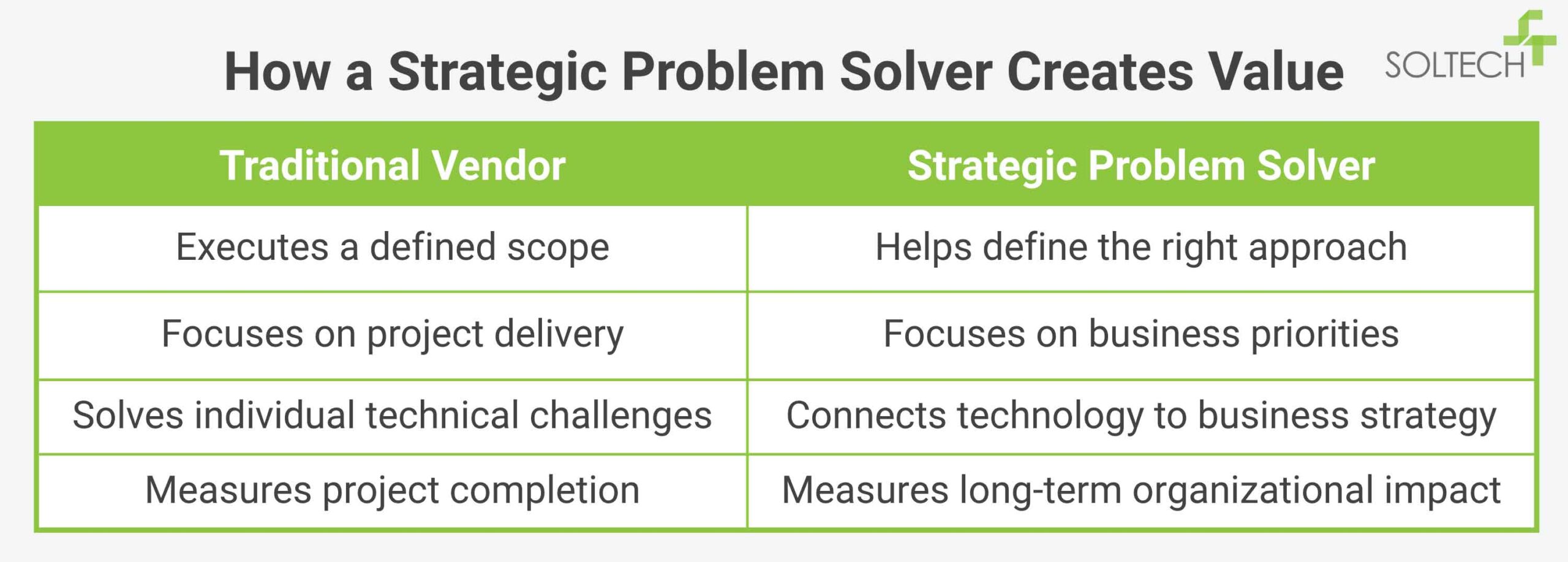
That’s where strategic problem solvers create the greatest value. Rather than focusing on individual projects or platforms, they help organizations understand how technology decisions fit into the bigger picture.
What Does This Look Like in Practice?
Imagine a growing organization preparing for its next phase of expansion. Leadership has identified several priorities: modernizing internal systems, improving customer experience, streamlining operations, and giving employees better access to information. As the team evaluates new enterprise software solutions and services, they also realize their existing infrastructure will need to evolve to support future growth.
Before launching multiple projects, leadership steps back to ask a different question:
What’s the underlying business challenge we’re trying to solve?
That conversation changes the direction of the entire initiative. Instead of treating each effort as a separate technology project, the organization develops a strategy that aligns technology investments with broader business priorities. The result isn’t simply fewer vendors. It’s greater clarity, stronger alignment, and a more deliberate approach to execution.
How Can Organizations Build Better Technology Partnerships?
Technology will continue to evolve, and organizations will continue investing in new capabilities.
What I believe will continue to change is what business leaders expect from the partners helping them navigate those decisions. Technical expertise will always matter. But expertise alone isn’t enough when organizations are balancing growth, competing priorities, organizational change, and increasing complexity.
The partners who create the greatest value will be the ones who help leaders simplify complexity, evaluate investments across enterprise infrastructure and IT solutions as well as enterprise software solutions and services, and connect every technology decision back to the business they’re trying to build.
Ultimately, organizations don’t succeed because they hire the most vendors or implement the newest technology. They succeed because they make better decisions. And that’s what strategic technology solutions should ultimately deliver.
FAQs
How do strategic technology solutions help enterprises achieve better business outcomes?
Strategic technology solutions help enterprises align technology investments with broader business objectives. Rather than treating initiatives as isolated projects, they connect technology decisions to organizational priorities, simplify execution, and improve alignment across teams. The result is better decision-making and stronger long-term business performance.
What should organizations look for in a strategic technology partner versus a traditional vendor?
A traditional vendor is typically responsible for delivering a defined service or project. A strategic technology partner takes a broader view by helping organizations evaluate priorities, identify tradeoffs, and ensure technology decisions support larger business goals. The strongest partners act as strategic problem solvers, guiding decision-making before implementation begins.
What role do enterprise software solutions and services play in solving complex business challenges?
Enterprise software solutions and services help organizations improve collaboration, streamline operations, and create better experiences for both employees and customers. Their greatest value comes when they’re selected as part of a broader business strategy rather than as standalone technology investments. When aligned with organizational priorities, they become a catalyst for growth instead of simply another system to manage.
Austin Smith
VP of Strategy and Operations Austin Smith is the Vice President of Strategy and Operations at SOLTECH, where he helps shape the company’s strategic direction, optimize internal operations, and drive innovation through emerging technologies. Since joining SOLTECH in 2020, Austin has played a key role in enhancing business systems and reporting, leading people operations, and advancing the strategic use of artificial intelligence. He holds a Bachelor of Science in Business Administration with a concentration in Information Systems Management from Auburn University.
In his role, Austin oversees the systems and processes that support service delivery while working closely with organizations evaluating technology initiatives and digital transformation strategies. Through ongoing conversations with CEOs, founders, executives, and IT leaders, he gains firsthand insight into the challenges, priorities, and decision-making processes shaping today’s technology investments.
Drawing on these conversations, along with his experience in strategy, operations, and business development, Austin shares practical insights on how organizations evaluate technology partners, navigate evolving market trends, and make informed technology decisions. His articles help business leaders identify the right strategies, build stronger partnerships, and create long-term business value.
Recent Posts
Search