

How to Develop and Test an AI Proof of Concept Before You Fund the Build
An AI proof of concept earns further investment by reducing uncertainty, not by producing an impressive demo. It should show whether a specific use case can create business value under realistic operating and technical constraints.
Business teams exploring generative AI often need to move from idea to evidence faster than a full planning cycle allows. A focused POC creates that evidence in a controlled environment. It tests the central business and technical assumptions before the organization commits to detailed architecture, integration, budgeting, change management, or implementation.
A rapid POC creates speed by narrowing the scope and concentrating rigor on the questions most likely to change the funding decision.
What Should an AI Proof of Concept Prove?
A strong POC should establish whether a narrowly defined AI capability can create useful business value under realistic constraints. It should evaluate more than model output by exposing the data, workflow, integration, security, governance, and ownership conditions that would shape a full implementation.
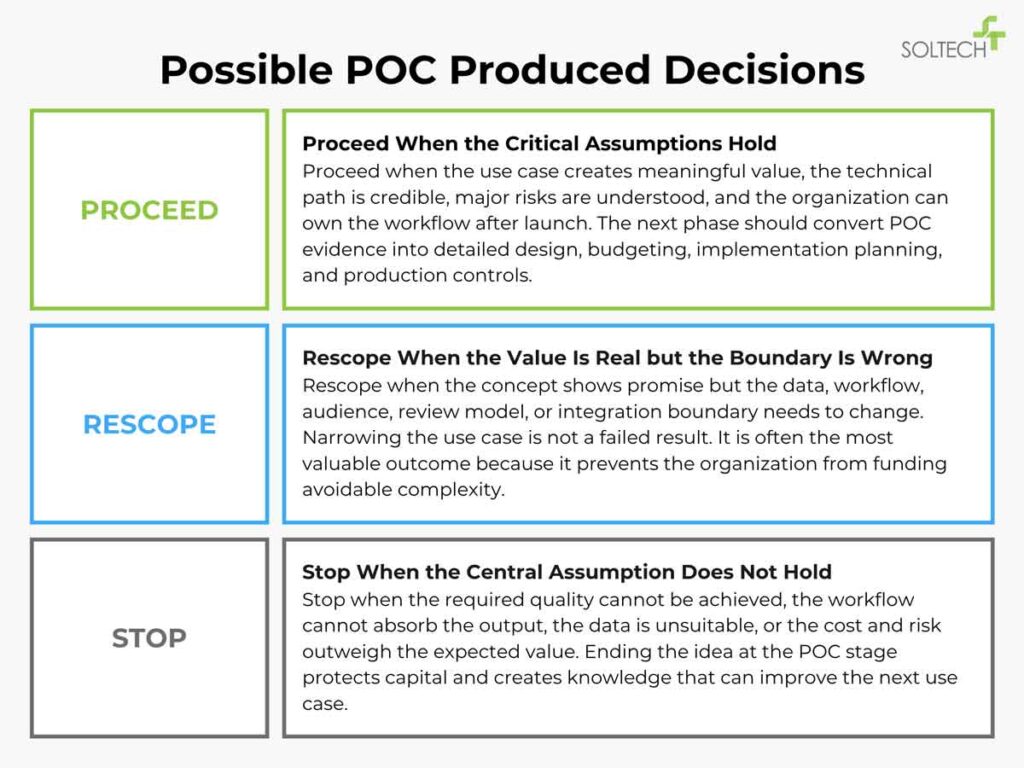
The deliverable is evidence that supports one of three decisions: proceed, rescope, or stop. Production-ready software comes later.
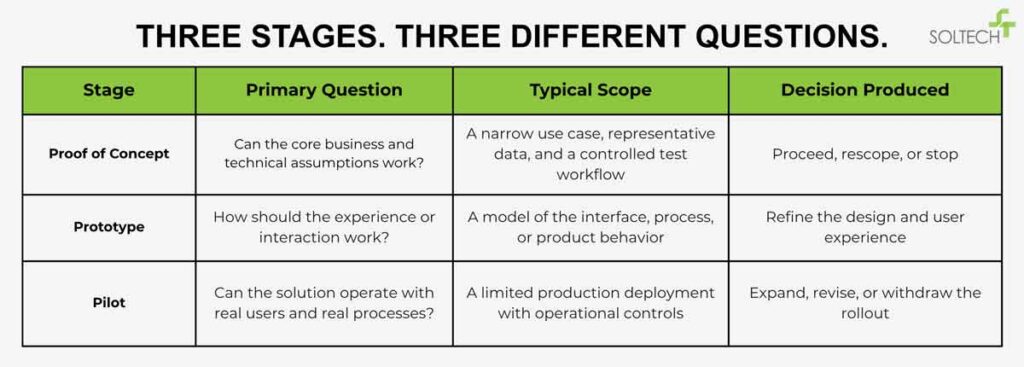
A POC Is Not the Same as a Prototype or Pilot
These terms are often used interchangeably, but they answer different questions. The distinction matters because each exercise requires a different level of design, integration, and operational commitment.
How Should Leaders Scope a Rapid POC?
Leaders should scope the exercise around a business decision, not around a model capability. A vague question such as “Can generative AI help our operations team?” invites an impressive demonstration but produces little evidence. A better question identifies the workflow, the intended improvement, the constraints, and the decision the evidence must support.
Start With the Workflow, Not the Model
The use case should begin and end inside a real business process. Define what enters the workflow, what decision or action occurs, who reviews the result, and what happens when the AI output is uncertain or wrong. This prevents the team from testing a model in isolation from the environment where it would actually create value.
Write the Hypothesis Before Development Begins
A useful hypothesis connects technical capability to an operational outcome. For example: “Using approved internal documents, the system can produce a reliable first draft that reduces review effort without introducing unacceptable factual or data-handling risk.” The POC can then test each part of that statement rather than drifting toward whichever output looks most promising during the demonstration.
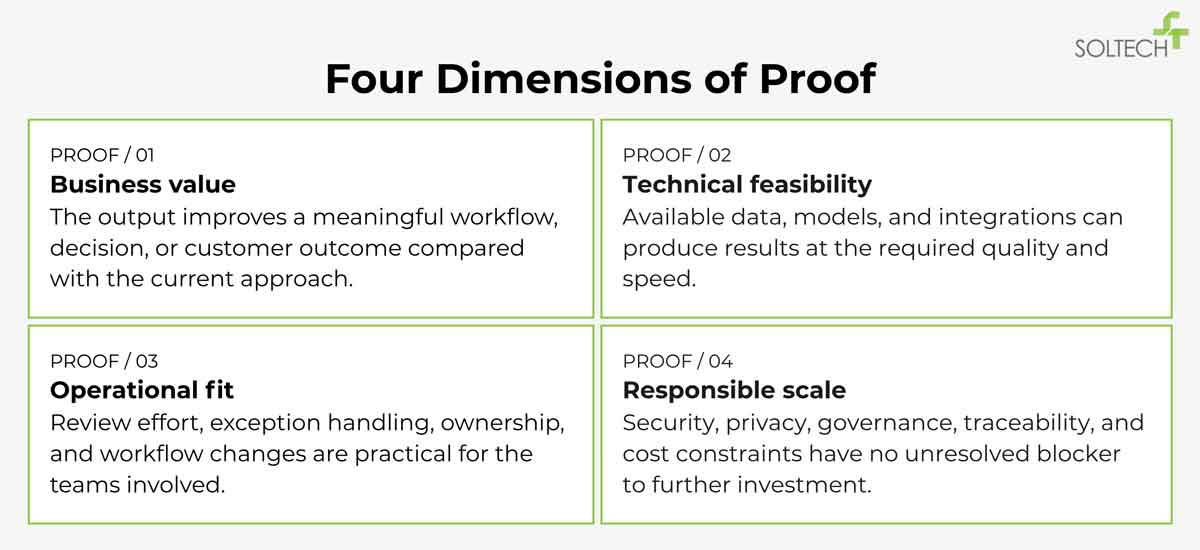
Define Four Dimensions of Proof
The following framework balances four types of evidence. Technical feasibility alone leaves business value, operational fit, and responsible scale unproven.
What Are the Key Steps in Developing the POC?
Development should follow a short, evidence-driven sequence. The goal is to build only enough of the future workflow to test the assumptions that matter.
1. Define the Use Case and Current Baseline
Document the current workflow before introducing AI. Identify the inputs, hand-offs, review points, failure conditions, and business outcome. The baseline does not need to be perfect, but the team needs a credible comparison. Without one, faster output can be mistaken for better performance even when review or coordination costs increase.
2. Assemble Representative Test Data
Use a controlled set of examples that reflects normal work, difficult cases, edge conditions, and known failure patterns. Remove or protect sensitive data according to the organization’s policies. A polished collection of easy inputs will tell the team whether the model can demonstrate the happy path, not whether the approach is dependable enough to fund.
3. Choose the Simplest Architecture That Can Answer the Question
The POC architecture should be intentionally thin. It may use a hosted model, a retrieval-augmented generation pattern, a small integration layer, structured outputs, and a basic review interface. It does not need the full production platform, but it should represent the important data and workflow boundaries well enough to expose real constraints.
4. Build a Thin End-to-End Workflow
A model response in a development console is not an operational test. Connect the minimum viable path from input to output, review, exception handling, and logging. This reveals where people, systems, and governance processes must coordinate, which is often where implementation risk accumulates.
5. Capture Evidence as the Team Iterates
Record model configuration, prompts, source data, outputs, reviewer decisions, latency, estimated operating cost, and failure patterns. Generative AI outputs vary, so one successful demonstration provides weak evidence. The team needs a traceable body of evidence that another reviewer can understand and challenge.
Worked Scenario: Testing Service Request Triage
Consider an operations team evaluating AI-assisted triage for incoming service requests. The POC uses a representative sample of historical requests, removes unnecessary personal data, and asks the system to classify the issue, recommend a destination, and draft a short summary for human review. The team compares those results with prior routing decisions, tracks disagreements, tests unusual requests, and measures the review burden. It does not build the full ticketing integration or automate the final routing decision.

That limited scope can still answer the funding question. It shows whether the data is usable, the classification is reliable enough, the review step is practical, and the remaining integration work is understood.
How Should an AI POC Be Tested?
Testing should show whether the approach remains useful as inputs, context, and operating conditions vary. Evaluate the workflow against defined quality, safety, reliability, and cost criteria instead of judging a few favorable model responses.
Test Task Quality Against the Baseline
Define quality in terms of the use case. Depending on the workflow, that may include correctness, completeness, relevance, consistency, classification quality, or adherence to a required format. Human reviewers should use agreed criteria rather than general impressions. Compare the results with the current process, not with an abstract idea of perfect AI performance.
Test Reliability, Edge Cases, and Failure Handling
Repeat important tests and vary the inputs. Include incomplete information, conflicting instructions, outdated source material, ambiguous requests, and content designed to push the system outside its intended boundaries. Document how failures are detected, what gets logged, when work returns to a person, and whether a safe fallback exists.
Test Workflow Fit and Ownership
A technically strong result can still create operational friction. Measure how much review the output requires, whether users trust it appropriately, who owns exceptions, and whether the proposed workflow shifts hidden work to another team. A POC should make coordination costs visible before they become embedded in the operating model.
Test Security, Governance, and Economics
Confirm which data enters the model, where it is processed, how access is controlled, what is retained, and which activity can be audited. Estimate the cost of model usage, retrieval, integrations, monitoring, and human review. The POC does not need every production control, but it must identify any requirement that could materially change the architecture, budget, or risk decision.

When Do Generative AI Development Services Add Value?
External generative AI development services can add value when the organization lacks specific capacity to design the evaluation, connect representative data, build the thin integration layer, or assess security and operational risks. An experienced team can keep the POC focused on business and workflow evidence rather than a plausible model response.
That support does not replace internal ownership. Business leaders must define the outcome, data owners must approve access, subject-matter experts must judge quality, and operational leaders must decide what level of risk and review is acceptable. The external team can structure the learning process, but it cannot decide what success means for the organization.
How Should the POC Inform the Funding Decision?
The funding decision should follow the evidence, including findings that challenge the original idea. A POC succeeds when it produces a clear, evidence-backed next decision, even when that decision is to rescope or stop.
What Does a Well-Designed POC Change?
A well-designed POC changes the funding conversation from speculation about what generative AI might do to evidence about what a specific workflow can support. Leaders see the constraints, trade-offs, ownership requirements, and production work that would shape a larger investment.
The exercise cannot remove every uncertainty or replace detailed planning. It should resolve the questions most likely to change the architecture, operating model, budget, or decision to proceed.
The POC supplies the evidence leaders need to decide whether the build is worth funding.
FAQs
Should Every AI Use Case Begin With a Proof of Concept?
A proof of concept is most useful when material uncertainty remains around business value, data suitability, technical feasibility, workflow fit, or risk. If the pattern is already proven and the constraints are well understood, targeted discovery or a limited pilot may be a better next step.
What Should Happen to POC Code After the Funding Decision?
POC code should usually be treated as learning code unless it was deliberately built to production standards. Teams can reuse validated concepts, evaluation assets, and architectural decisions, but they should review or rebuild the implementation for security, maintainability, scale, monitoring, and support.
Can an AI Proof of Concept Use Synthetic Data?
Synthetic data can support early testing and reduce exposure of sensitive information, but it must reflect realistic variability and edge conditions. Before production funding, the team should also validate the concept with governed, representative real data because synthetic datasets can hide data quality and integration problems.
Thayer Tate
Chief Technology Officer Thayer is the Chief Technology Officer at SOLTECH, bringing over 20 years of experience in technology and consulting to his role. Throughout his career, Thayer has focused on successfully implementing and delivering projects of all sizes. He began his journey in the technology industry with renowned consulting firms like PricewaterhouseCoopers and IBM, where he gained valuable insights into handling complex challenges faced by large enterprises and developed detailed implementation methodologies.
Thayer’s expertise expanded as he obtained his Project Management Professional (PMP) certification and joined SOLTECH, an Atlanta-based technology firm specializing in custom software development, Technology Consulting and IT staffing. During his tenure at SOLTECH, Thayer honed his skills by managing the design and development of numerous projects, eventually assuming executive responsibility for leading the technical direction of SOLTECH’s software solutions.
As a thought leader and industry expert, Thayer writes articles on technology strategy and planning, software development, project implementation, and technology integration. Thayer’s aim is to empower readers with practical insights and actionable advice based on his extensive experience.
Recent Posts
Search