

AI Automation vs. Augmentation: How Businesses Should Decide What Work AI Should Do
For many business leaders, the appeal of AI starts with productivity. That often leads to a straightforward question: What work can we automate?
But automation is only one way AI can create value. AI can also help employees analyze information, develop ideas, evaluate options, and make more informed decisions. This is AI augmentation: using technology to increase what people can do rather than simply removing people from the process.
For organizations trying to improve productivity without unnecessarily disrupting their workforce, the practical question is not whether to choose automation or augmentation. It is which parts of a workflow should be automated, which should be augmented, and which should remain meaningfully human-led.
Where AI Can Improve Business Decision-Making
AI augmentation can improve decision-making when it helps people process information, recognize patterns, compare alternatives, or surface relevant context more efficiently.
Consider a manager reviewing a large volume of customer feedback. AI can categorize comments, summarize recurring themes, and flag issues that deserve closer attention. That gives the manager a more efficient way to understand the information before deciding what the business should do about it.
The distinction matters because business decisions rarely depend on data alone. They can also depend on budgets, priorities, customer relationships, timing, risk, and organizational context.
NIST’s AI Risk Management Framework emphasizes defining human roles and responsibilities when people and AI systems interact. It also recognizes different human-AI configurations, from autonomous systems to situations where AI provides an additional input to a human decision-maker.
For leaders, the question is therefore not simply whether AI can contribute to a decision. It is what role the technology should play in the workflow.
Automation, Augmentation, or Human-Led Work?
Automation and augmentation solve different problems, and most businesses will need both. A third category is equally important: work that should remain primarily human-led.
A practical way to evaluate work is to ask what the task actually requires.
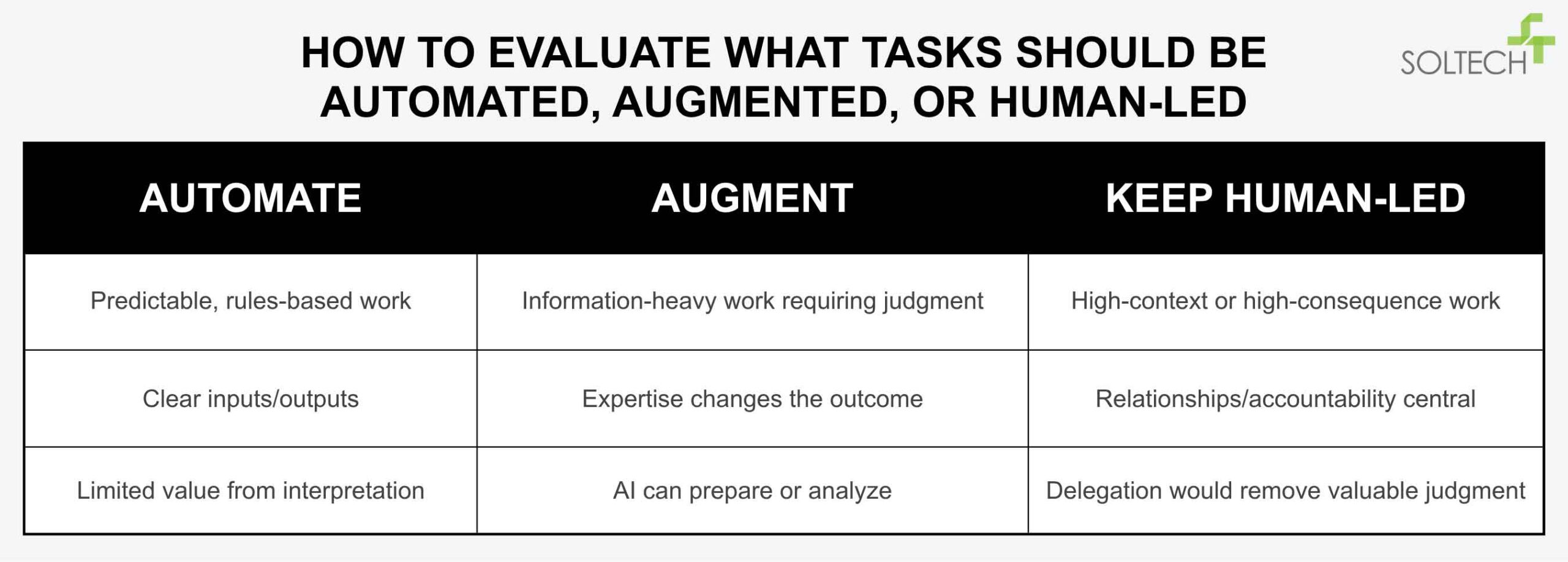
The distinction becomes more useful when leaders apply it to individual tasks rather than entire jobs.
Consider an inbound sales process. Technology can capture a form submission, verify required fields, update the CRM, and route the opportunity. AI might then summarize the prospect’s needs and organize relevant account information before a salesperson begins the conversation.
One workflow can therefore contain automated, AI-augmented, and human-led activities. The goal is not to force the entire process into one category.
Evaluate Tasks and Workflows, Not Entire Jobs
One of the easiest mistakes in AI planning is starting with a role and asking whether AI can replace it.
A better approach is to break the workflow into individual activities. A single job may contain administrative work that can be automated, analytical work that can be augmented, and strategic or interpersonal responsibilities that remain human-led.
Leaders can evaluate a workflow with four questions:
1. Where is the time going?
Identify activities where employees spend disproportionate effort searching, copying, summarizing, categorizing, comparing, or preparing information.
2. What does the task require?
Determine whether it is primarily rules-based, information-intensive, or dependent on context and expertise.
3. What would improve if AI were introduced?
Define the desired outcome, such as shorter cycle time, greater capacity, fewer errors, or faster customer response.
4. Can we evaluate the result?
The organization needs a reliable way to determine whether the output and the overall process are actually better.
This task-level approach helps businesses find useful AI opportunities without assuming that an entire role should be automated or augmented.
It also creates a better foundation for measurement.
AI may make one step dramatically faster without improving the workflow as a whole. If employees can produce ten analyses in the time it previously took to create two, for example, the organization still needs the capacity to review and act on them. The bottleneck may simply move.
Measure cycle time, quality, error rates, review effort, throughput, or another outcome tied to the original business problem. The goal is not to prove that employees are using AI. It is to determine whether the work improved.
How AI-Augmented Engineering Can Improve Software Development Efficiency
Software development provides a useful example of augmentation because AI can accelerate specific engineering activities, including generating code, creating tests, drafting documentation, explaining unfamiliar code, and exploring possible solutions.
Research suggests these tools can improve productivity under certain conditions. A 2025 study examined randomized controlled trials at Microsoft, Accenture, and an anonymous Fortune 100 company. Across 4,867 developers, researchers reported a 26.08% increase in completed tasks among developers with access to an AI coding assistant. The study also found higher adoption and larger productivity gains among less experienced developers.
Those findings should not be treated as a universal productivity benchmark. The research involved specific organizations, tools, developers, and measures of productivity, and the researchers noted uncertainty in the individual experimental estimates.
For business leaders, the more important point is that writing code is only one part of building successful software. Faster execution does not answer questions about what should be built, how it should fit into the broader technology environment, or whether it solves a worthwhile business problem.
Building the wrong feature faster is not meaningful productivity.
How AI Augmentation Is Changing Work and Learning
The same shift is happening across knowledge work. AI can take on portions of searching, drafting, analyzing, and preparing information, changing where employees spend their time.
A financial analyst might use AI to explore a dataset. A customer service representative might start with a suggested response. An employee learning an unfamiliar subject might use AI to explain a concept or compare approaches while completing a task.
This can make learning more closely connected to everyday work, but it creates a tradeoff. AI can help someone reach an answer faster without necessarily helping that person understand why the answer is correct.
That makes the ability to evaluate AI-assisted work increasingly important. Organizations need more than employees who know how to use AI tools. Domain expertise, problem framing, critical evaluation, and recognizing incomplete or unreliable information remainimportant capabilities.
The goal should be to use AI to extend expertise, not substitute for developing it.

Where Should Businesses Start With AI Augmentation?
The best starting point is usually a business process where employees already experience meaningful friction, not a list of AI capabilities.
Look for work that consumes significant time because people must search, summarize, compare, categorize, or prepare information. Then ask whether removing the person entirely would sacrifice important context or expertise.
From there, define the business outcome you want to improve and determine whether the organization can reliably evaluate AI’s contribution.
That sequence matters. Starting with a tool and searching for somewhere to deploy it can produce activity without solving an important problem. Starting with workflow friction gives the organization a reason to use AI and a way to judge whether the investment is worthwhile.
In some cases, AI will not be the right answer. Poor data, unclear ownership, unnecessary process steps, or inadequate systems may need to be addressed first. Augmenting a poorly designed process can simply make an inefficient process run faster.
Human Oversight Has to Be Designed
“Human in the loop” is not a control by itself.
For meaningful AI-assisted workflows, leaders need to define what people are expected to review, what information they need, when an output should be challenged, and who owns the final decision. NIST’s AI Risk Management Framework similarly calls for organizations to define roles and responsibilities for human-AI configurations and AI oversight.
The level of oversight should reflect the consequences of the use case. Organizing meeting notes does not require the same controls as using AI to inform employment, financial, legal, safety, or other consequential decisions.
For higher-impact workflows, leaders should be able to answer:
- What information can the AI access?
- How will important outputs be validated?
- What happens when the AI is uncertain or wrong?
- Which decisions require explicit approval?
- Who owns the final outcome?
- How will errors and exceptions be tracked?
The higher the consequence of a mistake, the more deliberate the oversight should be.
The Goal Is Better Work, Not More AI
The shift from automation to augmentation does not mean businesses should stop automating. Predictable, repetitive work may still be better handled by automation. Other tasks benefit from AI assistance, while some should remain primarily human-led.
The mistake is assuming every AI opportunity should lead to the same outcome.
Start with a meaningful workflow. Break it into tasks. Identify where time and friction exist. Decide which activities should be automated, augmented, or kept human-led. Then measure whether the entire workflow becomes faster, more reliable, or more valuable without creating unacceptable risk or new bottlenecks.
The objective is not to put AI everywhere. It is to put AI where it makes the organization more capable.
Frequently Asked Questions About AI Automation and Augmentation
Does AI augmentation require businesses to redesign existing workflows?
Not always. Some AI tools can support an existing workflow with minor changes, while other use cases may require a larger redesign. Before changing the process, businesses should understand whether the real constraint is the technology, the workflow itself, or both.
How should businesses decide whether to build or buy an AI augmentation solution?
The decision depends on the use case, available products, and how specialized the business requirements are. Leaders should consider integration, data access, security, governance, cost, maintenance, and whether a custom capability would provide enough business value to justify the investment.
Austin Smith
VP of Strategy and Operations Austin Smith is the Vice President of Strategy and Operations at SOLTECH, where he helps shape the company’s strategic direction, optimize internal operations, and drive innovation through emerging technologies. Since joining SOLTECH in 2020, Austin has played a key role in enhancing business systems and reporting, leading people operations, and advancing the strategic use of artificial intelligence. He holds a Bachelor of Science in Business Administration with a concentration in Information Systems Management from Auburn University.
In his role, Austin oversees the systems and processes that support service delivery while working closely with organizations evaluating technology initiatives and digital transformation strategies. Through ongoing conversations with CEOs, founders, executives, and IT leaders, he gains firsthand insight into the challenges, priorities, and decision-making processes shaping today’s technology investments.
Drawing on these conversations, along with his experience in strategy, operations, and business development, Austin shares practical insights on how organizations evaluate technology partners, navigate evolving market trends, and make informed technology decisions. His articles help business leaders identify the right strategies, build stronger partnerships, and create long-term business value.
Recent Posts
Search