

How Technical Debt Limits AI Implementation
AI implementation often stalls where business systems are hardest to access, trust, or change. A capable model cannot compensate for customer records that disagree, business rules that live only in employees’ heads, or applications with no dependable way to exchange data.
In most of the AI conversations I have with business leaders, the model turns out to be the easy part. The harder question is whether the systems around it can supply trustworthy data and safely act on what it produces.
Technical debt sets the practical boundary of an AI initiative, but leaders do not need to clear all of it before they proceed. They should fix the debt that blocks a priority workflow, include scaling debt in the production plan, and leave tolerable debt alone until the business case changes. That approach keeps AI funding tied to a dependable workflow instead of turning the initiative into a broad modernization program.
Blocking debt prevents the workflow from operating safely or reliably. Scaling debt allows a proof of concept but will fail under production demand. Tolerable debt sits outside the workflow or behind a stable boundary. These three tiers should determine what leaders fund now, plan next, and defer.
What Counts as Technical Debt in an AI Context?
In an AI context, technical debt is the accumulated design and operating friction that makes systems harder to trust, connect, or change. It includes aging code, but the practical question is whether a specific workflow can supply dependable context, apply the right rules, and control what the AI is allowed to do.
Employees often keep technical debt manageable through manual checks and shared context, but AI does not inherit that judgment automatically. For a selected workflow, the three issues that matter most are inconsistent data, brittle integration paths, and undocumented business rules. Leaders should assess those constraints against the workflow instead of treating every aging system as an immediate remediation project.
When Old Constraints Start Defining What AI Can Do
Traditional software teams often experience technical debt as slower delivery. For AI, some debt changes whether the use case is feasible at all. A forecasting assistant cannot produce a dependable view if product and revenue definitions differ across systems. An agent cannot update a customer record safely if the application offers no permissioned integration path. A service model cannot learn from past resolutions if those outcomes were never captured consistently.
The Workaround Your Team Knows Is the Work AI Cannot See
When systems remain fragmented, people fill the gaps. They compare records, interpret exceptions, correct stale information, and decide which source to trust. An AI implementation that ignores this work may appear efficient during a demonstration while shifting more review and correction to operations. That review burden is part of the cost of the solution and should be measured before the workflow expands.
I have seen situations where a business wants AI to automate a process that currently depends on one person. That employee downloads data from two systems, cross-references the records, and produces the final output the business relies on. AI can take over the cross-referencing, but only after we connect it to both data sources and document how that employee handles edge cases and data quality problems. Those judgment calls are where the team’s tribal knowledge lives, and they are exactly the work AI cannot see until someone writes it down.
Where Does Technical Debt Begin to Shape the AI Plan?
The assessment should follow the workflow from input through decision, action, exception handling, and ownership, then classify each constraint as blocking, scaling, or tolerable. The table below identifies the five areas where technical debt most often changes an AI plan.
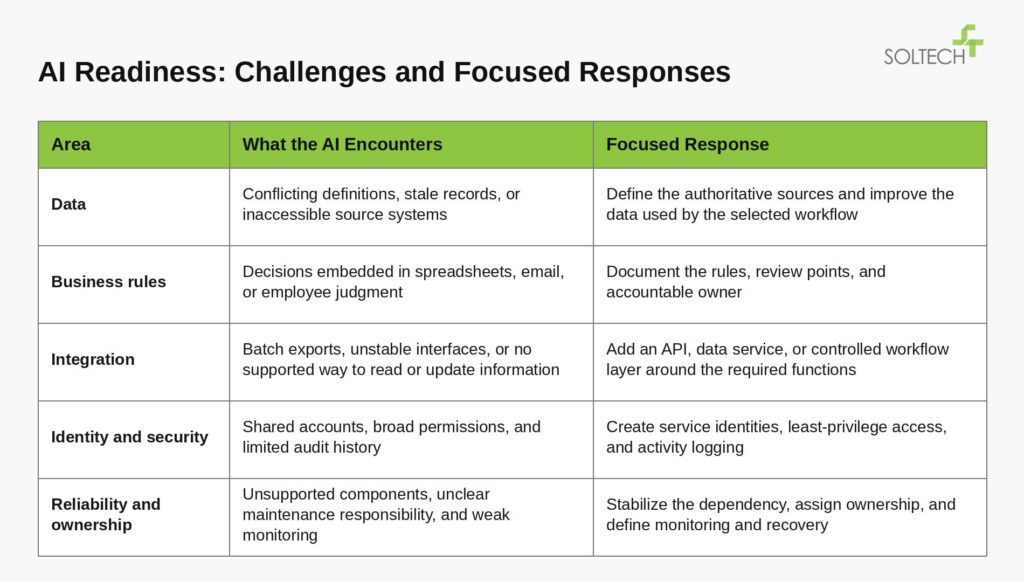
Identity and security determine what AI can see and do. A production design needs a service identity, least-privilege permissions, and an audit record for each action. If the only integration option uses a shared administrator account, that access path is blocking debt.
Reliability and ownership determine who detects failures and who restores service. Monitoring, recovery procedures, and a named owner may be scaling debt during a limited proof of concept, but they become requirements before a workflow carries production volume or customer commitments.
This view keeps the assessment specific. A decades-old finance application may be tolerable if the use case does not depend on it. A small spreadsheet may be blocking debt if it contains the only reliable version of a rule the AI is expected to apply. Age alone does not determine priority. The workflow does.
Why Does Data Quality Matter for AI Implementation?
Data quality matters because an AI system can only interpret the business through the information it receives. Gartner reported in February 2025 that organizations would abandon 60% of AI projects unsupported by AI-ready data through 2026. That prediction connects data discipline directly to project viability, not only model accuracy.
Retrieval-augmented generation can help a model use internal documents and records, but retrieval does not resolve contradictions in the source material. If two systems define an active customer differently, the AI still needs a rule for which definition governs the task. If a policy document is obsolete but remains searchable, the system may ground an answer in the wrong instruction.
The organization does not need to repair every dataset before beginning. It needs a governed slice of data that represents the selected workflow. That means naming the authoritative sources, checking freshness and completeness, and protecting sensitive information while testing the difficult cases employees encounter in practice. Improvements made for that slice can support other use cases later, but the first investment should remain tied to a business need.
How Can AI Work With Legacy Systems?
AI can work with legacy systems when the implementation creates a controlled boundary around the information and actions the workflow requires. Full replacement is one option, but it is usually the most disruptive and expensive starting point. Many organizations can make progress through a smaller integration layer.
Start by Letting AI Observe Before It Acts
A read-only implementation carries less operational risk than one that changes records or initiates transactions. The first version might collect context, summarize a case, flag inconsistencies, or recommend a next step for human review. This approach tests data access and workflow value before the team grants the system authority to act.
Give AI a Safe Way Into the System
An API facade, workflow platform, or Model Context Protocol (MCP) server can give AI a defined path into a legacy system. MCP is useful when an AI agent needs a standard way to discover and call approved tools, but the underlying services must still enforce authorization, validation, and activity logging. The boundary should expose only the information and functions the use case needs.
For a closed application with no supported interface, robotic process automation or screen automation may provide a temporary bridge. That choice creates its own maintenance obligation because interface changes can break the automation. Leaders should treat it as a managed dependency with an owner and an exit condition, not as invisible infrastructure.
Keep Recommendations Separate From Actions at First
The architecture should distinguish between producing a recommendation and executing a consequential action. Human approval, transaction limits, permission checks, and reversible steps can narrow the risk while the organization learns how the system behaves. Broader autonomy should follow evidence from the workflow, not the availability of a more capable model.
Modernize Only Where the Workflow Demands It
Targeted modernization becomes necessary when the legacy dependency cannot provide timely data, enforce access controls, sustain the expected transaction volume, or support reliable recovery. The AI initiative can clarify that boundary. It gives leaders a specific reason to replace or refactor part of the environment rather than funding a broad modernization effort with no agreed operational outcome.

How Should Leaders Prioritize Technical Debt for AI?
Leaders should prioritize technical debt according to its effect on one valuable workflow. The most useful sequence is to resolve immediate obstacles, prepare for production demands, and defer changes that do not yet justify investment.
Clear the Obstacles That Stop the Workflow
Identify the data, integration, and security issues that must be resolved before the workflow can operate responsibly. Fund those fixes first, or narrow the use case to avoid dependencies that cannot yet be addressed.
Then Address What Will Break Under Real Use
Include monitoring, ownership, and pipeline reliability improvements in the production plan. Teams can begin testing with manual oversight, but they should establish clear remediation milestones and funding requirements before expanding the workflow.
Let the Rest Wait Until the Business Case Changes
Document which issues can remain unresolved, who owns those dependencies, and what conditions would trigger reconsideration. Revisit them when business value, operating costs, or risk justify further investment.
When a Delayed Order Pulls Several Systems Into One Decision
Consider a distributor that wants AI to help customer service teams resolve delayed orders. Order data sits in an older enterprise resource planning system, carrier status arrives in scheduled files, customer priorities live in a CRM platform such as Salesforce or Microsoft Dynamics 365, and operations maintains exception rules in spreadsheets. Replacing every system would delay the initiative and introduce more change than the use case requires.
The spreadsheet exception rules and scheduled carrier files are blocking debt because the AI cannot resolve a delayed order reliably without them. Weak pipeline monitoring is scaling debt because a small proof of concept can operate with manual oversight, but production volume cannot. The older ERP interface is tolerable debt if a stable data service contains it and the workflow does not need to write back.
A focused approach creates that data service, documents the exception rules, and assigns an owner. The AI summarizes the case and recommends a response, while an employee approves any customer commitment. The organization fixes the debt that blocks reliable service and learns where later modernization would produce broader value.
What Should Leaders See Before Funding the Integration?
Before funding integration, leaders should be able to trace the proposed AI capability through a real workflow and explain where the implementation depends on existing systems. The decision should answer the following questions.
- Which business outcome and workflow justify the investment?
- Which systems and datasets supply the authoritative context?
- Which decisions depend on undocumented rules or manual reconciliation?
- What is the safest supported path for reading information and taking action?
- Who owns data quality, exceptions, monitoring, and maintenance after launch?
- Which debt must be fixed now, which must be included in the production plan, and which can remain?
These questions turn a general modernization concern into a bounded investment decision. They also prevent an AI project from absorbing every unresolved technology issue in the company.
What Changes When Debt Is Evaluated by Use Case?
A use-case approach changes the conversation from whether the organization has modern technology to whether a specific workflow can support dependable AI.
Technical debt will not disappear before AI implementation, and it does not need to. Leaders need a clear view of which constraints affect value, safety, operating cost, and long-term ownership. With that view, AI work and modernization can proceed together, each investment tied to an operational result rather than a broad cleanup mandate.
Frequently Asked Questions About Technical Debt, AI Implementation, and Legacy System Modernization
Can an AI Vendor Connector Resolve Conflicting Business Data?
A connector can provide access to systems, but it cannot decide which conflicting definition or record the business should trust. The organization still needs data ownership, agreed definitions, and rules for resolving discrepancies.
Who Should Own Technical Debt Discovered During an AI Project?
Ownership should be shared between the leader accountable for the business workflow and the technology owner responsible for the affected system. The business owner defines the operational consequence and priority, while the technology owner defines the remediation path and maintenance obligation.
Should Remediation Come From the AI Budget or the Modernization Budget?
Use-case-specific work usually belongs in the AI initiative, while improvements that create a shared capability across several products or workflows may belong in a modernization program. Separating those costs helps leaders see the true economics of the AI use case without charging one project for every historical system problem.
Does Cloud Migration Remove Technical Debt Before AI Implementation?
Moving an application to cloud infrastructure can improve hosting, resilience, or access to managed services, but it does not automatically correct fragmented data, undocumented rules, brittle interfaces, or unclear ownership. Those design and operating issues require separate decisions during migration or later modernization.
Thayer Tate
Chief Technology Officer Thayer is the Chief Technology Officer at SOLTECH, bringing over 20 years of experience in technology and consulting to his role. Throughout his career, Thayer has focused on successfully implementing and delivering projects of all sizes. He began his journey in the technology industry with renowned consulting firms like PricewaterhouseCoopers and IBM, where he gained valuable insights into handling complex challenges faced by large enterprises and developed detailed implementation methodologies.
Thayer’s expertise expanded as he obtained his Project Management Professional (PMP) certification and joined SOLTECH, an Atlanta-based technology firm specializing in custom software development, Technology Consulting and IT staffing. During his tenure at SOLTECH, Thayer honed his skills by managing the design and development of numerous projects, eventually assuming executive responsibility for leading the technical direction of SOLTECH’s software solutions.
As a thought leader and industry expert, Thayer writes articles on technology strategy and planning, software development, project implementation, and technology integration. Thayer’s aim is to empower readers with practical insights and actionable advice based on his extensive experience.
Recent Posts
Search