


The Real Cost of AI Implementation: Why So Many AI Projects Go Over Budget
Budgeting for AI has become one of the biggest challenges facing business leaders today. Unlike traditional software investments, AI solutions can be priced in dramatically different ways depending on how they’re deployed, consumed, and integrated into existing systems.
As organizations evaluate opportunities ranging from AI-powered document search and customer service automation to intelligent quoting and workflow optimization, one question consistently rises to the top:
“How much does AI implementation cost?”
The answer is often more complicated than expected.
Understanding AI implementation costs has become critical for organizations evaluating generative AI, intelligent automation, AI-powered search, and custom AI applications. Yet many organizations struggle to estimate the full investment requiredand underestimate the hidden costs of AI implementation.
The same underlying AI technology might cost $30 per employee per month through a software subscription, several thousand dollars per month in API usage, or hundreds of thousands of dollars in infrastructure and implementation services.
This pricing complexity is one reason many AI initiatives exceed their original budgets. The issue is not that AI is inherently expensive. It is that organizations often underestimate what they are actually buying and the costs required to make AI deliver business value.
Gartner predicts that at least 30% of generative AI projects will be abandoned after proof of concept due to factors including escalating costs, poor data quality, inadequate controls, and unclear business value. These challenges often emerge when organizations underestimate the full scope of implementation and ongoing operational expenses.
The good news is that AI pricing is not a mystery. Once you understand the primary ways vendors price AI and where hidden costs tend to emerge, you can make more informed investment decisions and avoid costly surprises.
Before evaluating any AI initiative, business leaders should understand the four most common AI pricing models and the trade-offs that come with each.
How Much Does AI Implementation Cost?
One of the most common questions business leaders ask is, “How much does AI implementation cost?” The answer depends on the deployment model, integration requirements, data readiness, governance needs, and ongoing operational support.
While some AI solutions may cost only a few dollars per user each month, enterprise AI initiatives can require significant investments in infrastructure, integration, security, compliance, and change management. Understanding the full scope of AI implementation costs is essential for building realistic budgets and avoiding surprises later in the project.

Why Do AI Projects Go Over Budget?
Many organizations underestimate AI implementation costs because they focus on software licensing or model access while overlooking integration, data preparation, governance, security, and adoption requirements. As a result, AI projects often exceed their original budgets even when the underlying technology performs as expected.
Most budget surprises do not come from AI being expensive on its own. They come from a mismatch between how a company bought AI and how it ended up using it.
Think of it like commuting around a city. You can buy a monthly transit pass, take metered taxis, buy or rent a car, or ride a shuttle that comes included with your hotel. Every option gets you where you are going. But at the end of the month, the bills look nothing alike, and the reasons they grow are entirely different.
The same is true for AI. Before you can predict the cost, you have to know which one you are actually paying for.
What Are Four Ways to Pay for AI?
The Subscription: Renting a Seat
This is the AI most people have used: ChatGPT, Claude, Microsoft Copilot. You pay a flat fee per person, per month. For individuals that lands in the ballpark of $20. For the business version of Microsoft Copilot, it is roughly $30 per user, often on top of the Microsoft licenses you already pay for.
The bill grows in one direction only: with headcount. Add a person, add a fee. That makes it the most predictable of the four, the same way a monthly transit pass costs the same no matter how many trips you take. You can forecast it to the dollar. This shape tends to fit steady, day-to-day use, where a known group of employees lean on AI for writing, summarizing, and research.
The Meter: Paying for Every Use
This is where things get less familiar. When you connect to AI directly, through Anthropic Claude API, OpenAI API, or a cloud platform like Microsoft Azure OpenAI or Amazon Bedrock, you no longer pay per person. You pay per use.
Usage is measured in tokens, which are roughly pieces of words. You pay for the words going into the model and the words coming back, like a utility meter that runs whenever the system is working. A quiet month is cheap. A busy month is expensive. If a feature you built suddenly becomes popular, the bill climbs right alongside it. This is the model that powers AI built into products and applications, and it is where most cost surprises happen.
Ownership: Running It Yourself
The third option is running the AI models on your own servers, rented hardware, or cloud Infrastructure-as-a-Service (IaaS) deployments. Think of it as installing solar panels or buying a backup generator. The cost is large and mostly up front: powerful hardware, ongoing electricity, and people to keep it running. Once it is set up, the monthly spend is steady, but you have committed real money before processing a single request. This approach tends to fit very large, steady workloads, or data too sensitive to send outside the organization.
The Bundle: AI Built into Software You Already Use
This is the one most companies meet first, often without realizing it. Your CRM, your help desk, your accounting platform, and your design tools have all started adding AI features, with the cost folded into the product price. Salesforce, ServiceNow, Adobe, and others now ship AI inside the software you were already paying for. Microsoft did the same when it built Copilot into Microsoft 365, which is part of why the base price went up.
Think of it as a shuttle included with your hotel stay. You did not book the ride separately, it is baked into the nightly rate, and you have no say over the route or the schedule. The cost is easy to budget because it simply rides along with a bill you already pay. The catch is that you usually cannot see the AI portion on its own, you cannot tune how it works, and you are exposed to the vendor raising prices or moving AI into a more expensive tier. It is the fastest path to AI and the one where you hold the least control.
A cost to watch for: “bring your own key.” Not every product that includes AI pays for the AI itself. Some ask you to connect your own AI account, a setup often called “bring your own key,” and their features then run on it. That means two bills, not one: the product license you expected, plus the metered token usage flowing through your own account on top of it. If you budgeted only for the license, that second bill is a genuine surprise. Before buying any product that advertises built-in AI, ask one question: is the AI usage included in the price, or am I supplying and paying for it separately?
Which AI Cost Model Fits Your Business Need?
One of the biggest misconceptions about AI is that there is a universally “best” pricing model. In reality, the right model depends on what you’re trying to accomplish.
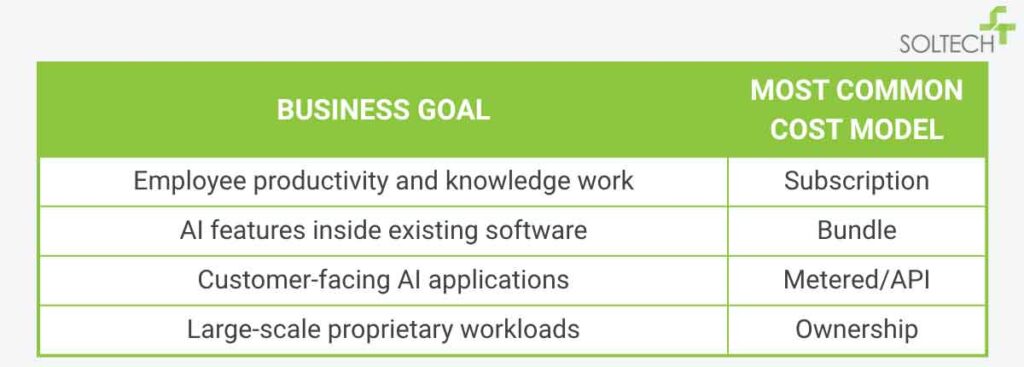
For example, an organization rolling out Microsoft Copilot to employees values predictability and simplicity. A software company embedding AI into its product needs flexibility and scalability. A healthcare organization handling sensitive data may prioritize control and compliance.
The most expensive AI projects are often not the ones using the most advanced technology. They’re the ones using the wrong cost model for the business problem they’re trying to solve.
Why Does the Same AI Model Cost Different Amounts?
Here is the part that trips up even experienced leaders. The subscription and the meter are often selling access to the same model, or one very close to it.
The Claude or GPT behind a $20 monthly subscription is the same underlying system a company rents through the API. What changes is how you are billed, and whether the price is subsidized.
A subscription is partly subsidized. Whether a user sends two requests a day or two hundred, the price does not move, because the provider absorbs the heavy users. The API removes that cushion entirely. There, you pay the real cost of everything the model reads and writes, with nothing absorbed on your behalf.
The bundle adds one more layer. When AI is built into software you already use, the vendor usually pays that metered cost behind the scenes and wraps it into your subscription, often with a margin on top. You are still paying for the meter. You just never see it.
This is why a tool that feels nearly free at $20 a month can become a meaningful line item the moment you move the same work onto the API to build something. The model did not get more expensive. The subsidy simply went away.
Which Pricing Model Is Easiest to Control?
Line them up, and they sort by how predictable, and how controllable, the bill is. Those are not always the same thing.
The subscription is the easiest to control. The cost is headcount times a fixed fee, so the only real lever is how many people you give access to. Heavy users do not change the number, and you will almost never be surprised by the invoice.
The meter is the hardest. The bill follows usage, and usage can spike for reasons that have nothing to do with how many people you employ. Keeping it in check takes active work: setting budgets, watching dashboards, and using smaller models for simpler tasks. This is where almost all of the budget surprises come from.
Ownership sits in between. Once the hardware is paid for, the monthly number is steady and predictable. The risk simply changes shape, from an unexpected spike to paying for capacity you are not fully using.
The bundle is the most predictable to budget, but the least transparent. It arrives as part of a bill you already pay, so it rarely shocks you. The trade is that you cannot see or optimize the AI cost on its own, and the vendor, not you, decides what it costs next year.
What Hidden Costs of AI Implementation Should You Plan For?
Many organizations discover that the hidden costs of AI implementation are not associated with the AI software itself. Instead, costs often emerge from the work required to integrate AI into existing business systems, prepare data, establishgovernance, and support long-term adoption.
The AI software itself is often only a portion of the total investment. What catches many organizations off guard are the costs required to make AI useful inside the business.
Integration
AI creates the most value when it can interact with the systems employees already use. Connecting AI to ERP platforms, CRMs, document repositories, internal databases, and business workflows requires planning, development, testing, and ongoing support.
For many organizations, integration costs exceed the cost of the AI platform itself.
Data Readiness
AI performs best when it has access to organized, trustworthy information. If data is scattered across departments, duplicated across systems, or poorly maintained, organizations often need to invest in cleanup and governance before AI can deliver meaningful results.
Security and Compliance
Industries such as healthcare, financial services, logistics, and manufacturing often have security, privacy, and regulatory requirements that influence how AI can be deployed. These considerations frequently add implementation effort and operational overhead.
Change Management
Technology adoption is ultimately a people challenge. Training employees, establishing governance policies, and helping teams integrate AI into daily workflows all require time and investment.
This is why AI projects frequently exceed their initial budgets. The technology isn’t necessarily more expensive than expected. The surrounding work required to operationalize it often is.
What This Looks Like in Practice
The same AI technology can create very different cost structures depending on the business problem.
A manufacturer might use AI to help employees locate engineering documentation and operating procedures. Because usage is tied to a known group of employees, a subscription model may be the most predictable option.
A logistics company might deploy AI to automate quoting, shipment updates, and customer inquiries. In this scenario, a usage-based model often makes more sense because demand fluctuates with customer activity.
A healthcare organization may prioritize security, compliance, and control over cost optimization. For those organizations, ownership or tightly managed cloud deployments can be worth the additional investment.
The right answer depends less on the AI model itself and more on the operational realities of the business.
Key Takeaways About AI Implementation Costs
- AI implementation costs vary significantly based on deployment model, usage patterns, and business goals.
- Subscription, API, ownership, and bundled AI each create different cost structures.
- The hidden costs of AI implementation often exceed the cost of the AI software itself.
- Organizations that align AI spending with business value are more likely to achieve positive ROI.
The Goal Isn’t Cheaper AI
Many organizations begin their AI journey by asking how to reduce costs. A better question is how to align AI spending with business value.
Organizations that accurately estimate AI implementation costs are better positioned to select the right deployment model, avoid budget overruns, and achieve measurable business outcomes. The goal is not simply to reduce costs, but to align AI investments with long-term value.
A customer-facing application that drives revenue may justify variable usage costs. An employee productivity initiative may benefit from predictable per-user pricing. Highly regulated environments may require greater investment in control and governance.
The organizations seeing the strongest return on AI investments are not necessarily choosing the cheapest option. They’re choosing the pricing model that best supports the outcome they’re trying to achieve. That’s why successful AI initiatives begin with strategy before technology.
At SOLTECH, we help organizations evaluate where AI can create measurable value, determine the most appropriate deployment approach, and avoid the costly surprises that often derail otherwise promising projects. The goal is not simply to adopt AI. It’s to invest in it wisely.
FAQs
How much does AI implementation cost?
AI implementation costs can range from a few hundred dollars per month for subscription-based tools to hundreds of thousands of dollars for enterprise AI initiatives. The total investment depends on the deployment model, integration complexity, data readiness, security requirements, and ongoing support needs.
Why do AI projects go over budget?
AI projects often go over budget because organizations focus on software costs while underestimating integration work, data preparation, governance requirements, change management, and ongoing operational support.
What are the hidden costs of AI implementation?
The hidden costs of AI implementation commonly include system integrations, data cleanup, security and compliance requirements, employee training, governance policies, and long-term maintenance.
What factors have the biggest impact on AI implementation costs?
The largest cost drivers are deployment model selection, usage volume, integration requirements, data quality, security controls, regulatory compliance, and organizational adoption efforts.
Is AI implementation more expensive than traditional software projects?
Not necessarily. However, AI implementation often introduces additional considerations such as model usage fees, data preparation, governance, and ongoing monitoring that can increase total project costs if they are not planned for properly.

Cory Loriot
Solutions Architect Cory is a Solutions Architect at SOLTECH, bringing 20+ years of experience across software development, cloud architecture, and technology consulting to his role. His work focuses on helping organizations design and implement practical AI and cloud solutions, with hands-on experience across both the AWS and Azure platforms. Cory has spent much of his career solving complex technical problems for clients in healthcare, fintech, manufacturing, logistics, and government, where reliability, security, and cost each carry real weight.
Cory’s path into architecture was anything but linear. Over the years he has worked across software development, SharePoint and Microsoft 365 administration, enterprise architecture, and internal IT, much of it in consulting and contract roles where he was brought in to solve specific client problems. That unusually broad foundation shapes how he approaches system design today. At SOLTECH he continues that work, helping clients align their technology decisions with the outcomes their businesses need.
As a thought leader and industry expert, Cory writes about AI strategy and cost, cloud architecture, and the practical trade-offs behind real-world technology decisions. His aim is to cut through the hype and give readers clear, honest, and actionable guidance grounded in hands-on experience.
Recent Posts
Search