


How to Choose an AI Development Partner for Your Enterprise
Key Highlights
- Prioritize business outcomes. The right AI partner connects technical solutions to measurable operational improvements.
- Assess enterprise readiness. Data quality, system integration, and internal resources can determine whether an AI project succeeds.
- Evaluate risk and reliability. Security, governance, testing, and ongoing oversight should influence partner selection.
- Look beyond implementation. Choose a partner that offers transparent recommendations, relevant experience, and clear ownership responsibilities.
Choosing an enterprise AI partner requires more than evaluating technical capabilities or reviewing product demonstrations. The right provider should understand your business problem, determine whether AI is appropriate, assess implementation risks, and establish how success will be measured.
Enterprise buyers should evaluate partners across five areas: business understanding, measurable outcomes, delivery capability, risk management, and long-term ownership.
AI investment is expected to continue growing. In September 2026, Gartner forecast worldwide AI spending would reach approximately $3.64 trillion in 2027, up from a projected $2.67 trillion in 2026. While much of that spending includes infrastructure and technology platforms, the broader trend reinforces an important challenge for enterprise leaders: as AI investment expands, choosing where to invest and which partners can deliver measurable business value becomes increasingly important.
What Should You Look for in an Enterprise AI Partner?
The right AI partner should help determine what is worth building, not simply demonstrate what the technology can do.
Consider a company struggling with slow customer onboarding. Leadership might assume it needs an AI-powered application, but the underlying problem could involve disconnected systems, inconsistent data, or unnecessary manual approvals.
A partner focused on business outcomes should investigate these possibilities before recommending AI.
Look for a provider that can understand the business problem, evaluate alternatives, identify operational constraints, and recommend an approach suited to your organization’s priorities and resources.
One useful early indicator is whether the partner asks detailed questions about your business processes before proposing specific technologies.

How to Evaluate an AI Partner’s Business Case
An impressive AI demonstration does not establish a business case. Buyers need to understand what the solution will improve, how success will be measured, and what implementation will cost.
Consider an organization evaluating AI for contract review. A tool might summarize documents in seconds, but its value depends on whether it improves the overall review process without introducing unacceptable errors.
If employees spend as much time validating AI-generated summaries as they previously spent reviewing documents, the operational benefit may be limited.
A prospective partner should establish three elements:
- The baseline: What does the existing process cost in time, resources, errors, or missed opportunities?
- The expected improvement: What measurable change would justify the investment?
- The total cost: What will development, integration, infrastructure, usage, and ongoing support require?
For contract review, success measures might include average review time, human verification requirements, and error frequency.
These measures also help distinguish a promising pilot from a solution ready for production. A proof of concept demonstrates that something can work under defined conditions, not necessarily that it will remain reliable and economical in daily operations.
Can the Partner Deliver AI in Your Existing Environment?
An enterprise AI development company must understand how its solution will operate within your existing systems, data environment, and business workflows.
Even a technically capable application can fail to deliver value if integrations are unreliable, information is incomplete, or employees cannot use it effectively.
Evaluate Data and Operational Readiness
Before development, buyers should assess:
- Data quality: Is the required information accurate, accessible, and suitable for the intended use?
- Integration: How will the solution connect with existing applications and workflows?
- Security: What information will the system access, and how will it be protected?
- Internal capacity: Who will support and manage the solution after deployment?
Prospective partners should explain how they assess these requirements and identify limitations before development begins.
Plan for Production, Not Just a Demonstration
AI applications may behave differently when exposed to real users, unfamiliar inputs, changing data, and larger workloads.
Ask how the partner will test reliability, handle unexpected outputs, monitor performance, and respond to technology changes.
Operating costs also matter. Usage-based pricing, infrastructure, monitoring, and maintenance can affect the economics of an application as adoption grows.
The objective is a dependable business solution, not simply a functioning AI feature.
Buying AI Software vs. Building a Custom AI Solution
Enterprise buyers should consider whether an existing AI product, configured platform, or custom application best addresses their needs.
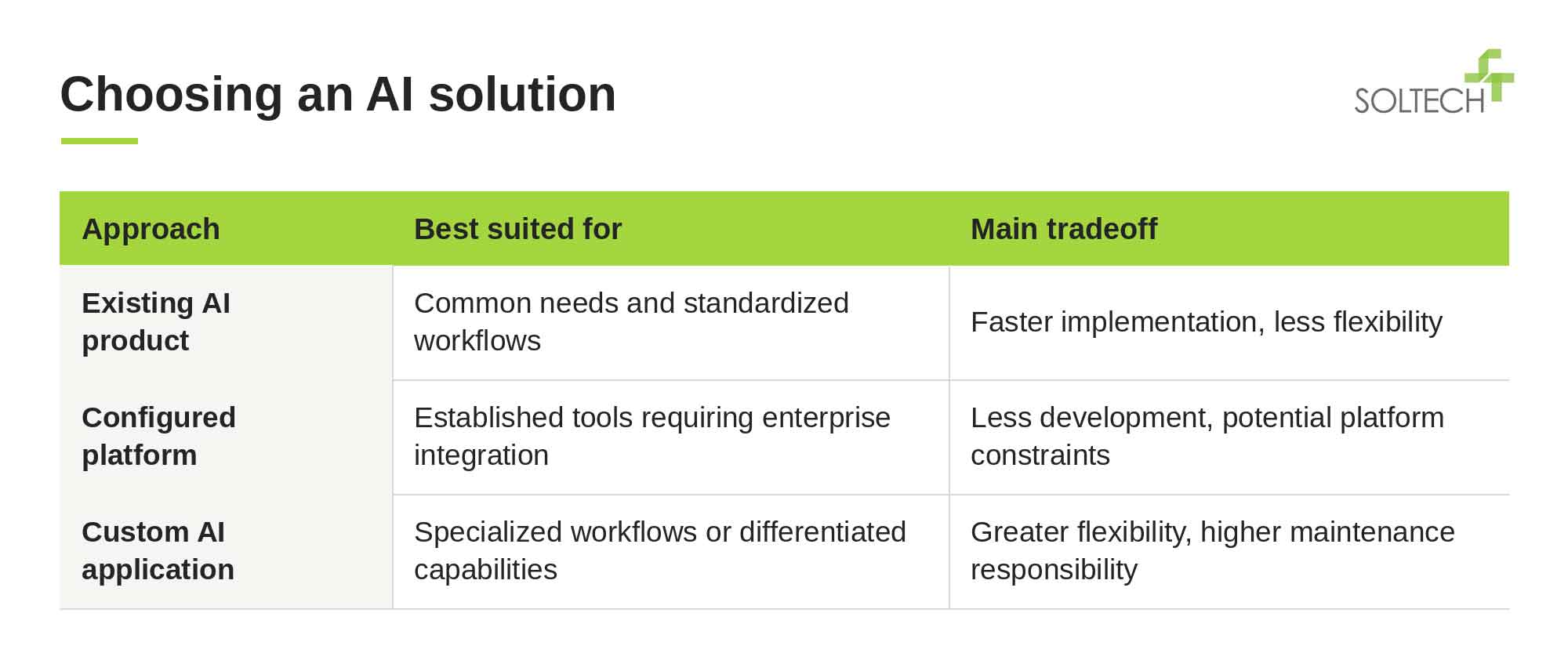
Custom AI development may be justified by specialized processes, complex integrations, or capabilities that provide competitive differentiation.
However, it also creates responsibilities for testing, maintenance, and future adaptation.
An AI application development company should explain when custom development is warranted and when an existing product would be more economical.
Compare total cost of ownership, implementation requirements, flexibility, and long-term responsibilities rather than focusing solely on the initial price.
Risk and Governance Should Influence Partner Selection
AI introduces risks including inaccurate outputs, sensitive information exposure, unpredictable behavior, and inappropriate reliance on generated recommendations.
The required safeguards depend on the application. Summarizing internal meeting notes presents different risks from using AI to support financial, employment, or legal decisions.
The National Institute of Standards and Technology’s AI Risk Management Framework provides a useful reference. Its four functions, Govern, Map, Measure, and Manage, support identifying, assessing, and managing AI risks throughout a system’s lifecycle. The framework is voluntary and intended for context-specific application.
As a buyer, ask yourself:
- What information can the AI system access, and how will it be protected?
- How will outputs be tested and monitored?
- Where is human review or approval necessary?
- How will failures and unexpected behavior be handled?
- Who is accountable for ongoing risk management?
For example, if an AI application processes sensitive internal documents, the partner should explain where information is processed, who can access it, and how data-handling requirements will be enforced.
The goal is not to eliminate every risk but to establish appropriate safeguards for the intended use.
What Should Each Phase of an AI Engagement Deliver?
A successful AI partnership requires clear expectations, defined responsibilities, and opportunities to validate assumptions before expanding the investment.
Discovery and Prioritization
The partner works with business and technical stakeholders to define the problem, assess constraints, evaluate alternatives, and identify a realistic starting point.
The outcome should include a recommended approach, major dependencies, and criteria for proceeding.
Validation and Implementation
The team tests important assumptions, including data suitability, integration feasibility, output quality, and operating costs.
Implementation then covers development or configuration, integration, testing, deployment, and preparation for operational use.
Deliverables and acceptance criteria should be agreed upon before broader implementation.
Ongoing Support and Improvement
After launch, the organization needs a plan for monitoring performance, resolving issues, and adapting the solution as requirements change.
Not every engagement requires one provider to handle all phases. Internal teams may own implementation or ongoing operations.
What matters is that responsibilities are explicit and essential work does not remain unassigned.
How to Compare AI Partners Before Making a Decision
Enterprise buyers should evaluate how prospective partners approach uncertainty, tradeoffs, and difficult decisions, not just their presentations or technical portfolios.
Four areas deserve particular attention:
- Business understanding: Does the partner investigate the underlying problem and challenge assumptions before recommending AI?
- Relevant experience: Has the team handled comparable integrations, data complexity, security requirements, or operational constraints? Can it provide credible examples?
- Transparency: Can the provider explain where AI may be unreliable, expensive, unnecessary, or difficult to maintain?
- Long-term flexibility: Will your organization retain appropriate control over its data, intellectual property, documentation, and future technology choices?
Compare Partners Using the Same Business Scenario
Give shortlisted providers the same realistic business problem and ask each to explain:
- Problem assessment: What would they investigate before recommending AI?
- Solution approach: Would they recommend an existing product, platform integration, or custom development, and why?
- Delivery evidence: What relevant experience or technical capabilities support their recommendation?
- Risk assessment: What limitations, dependencies, and failure scenarios would need attention?
- Success measurement: How would they determine whether the solution is working?
- Long-term ownership: Who would maintain the application and manage future changes?
Compare the reasoning and evidence behind each proposal rather than focusing only on features, timelines, or initial costs.
A strong partner should explain both the advantages and limitations of its recommendation.
Choose an AI Partner Based on Business Fit, Not Just Technical Capability
The right enterprise AI partner should help your organization make informed investment decisions, deliver solutions that work within existing operations, and manage responsibilities beyond implementation.
That does not always require custom development. An existing product or configured platform may meet the business need with less complexity and ongoing maintenance.
Before selecting a provider, define one meaningful business challenge and ask shortlisted partners to explain their approach. Compare their understanding of the problem, proposed solution, delivery evidence, success measures, and long-term ownership model.
The strongest choice is the partner whose recommendations are supported by clear reasoning, relevant experience, and a realistic plan for delivering business value.
Frequently Asked Questions About AI Partner Agreements
Should Businesses Work With One AI Partner or Several Specialized Providers?
A single partner can simplify coordination and accountability, while multiple providers may offer specialized expertise in data engineering, security, or AI development. The right arrangement depends on project complexity and your organization’s ability to coordinate delivery.
What Should Be Included in an AI Development Agreement?
An agreement should define deliverables, acceptance criteria, data and intellectual property ownership, security responsibilities, support obligations, and termination provisions. It should also clarify how scope changes and ongoing maintenance will be handled. Legal counsel should review the terms.
How Can Businesses Reduce Dependence on a Single AI Vendor?
Prioritize data portability, documented integrations, clear ownership rights, and a defined transition process. Some dependency may be unavoidable, but switching costs and limitations should be understood before committing.
Austin Smith
VP of Strategy and Operations Austin Smith is the Vice President of Strategy and Operations at SOLTECH, where he helps shape the company’s strategic direction, optimize internal operations, and drive innovation through emerging technologies. Since joining SOLTECH in 2020, Austin has played a key role in enhancing business systems and reporting, leading people operations, and advancing the strategic use of artificial intelligence. He holds a Bachelor of Science in Business Administration with a concentration in Information Systems Management from Auburn University.
In his role, Austin oversees the systems and processes that support service delivery while working closely with organizations evaluating technology initiatives and digital transformation strategies. Through ongoing conversations with CEOs, founders, executives, and IT leaders, he gains firsthand insight into the challenges, priorities, and decision-making processes shaping today’s technology investments.
Drawing on these conversations, along with his experience in strategy, operations, and business development, Austin shares practical insights on how organizations evaluate technology partners, navigate evolving market trends, and make informed technology decisions. His articles help business leaders identify the right strategies, build stronger partnerships, and create long-term business value.
Recent Posts
Search