


6 HR Hiring Metrics That Matter More Than Time-to-Fill
By Veanne Smith
For years, time-to-fill has been one of the most familiar recruiting KPIs. It helps organizations understand hiring speed and plan workforce needs, but it cannot show whether candidates stayed engaged, managers made effective decisions, or new hires ultimately succeeded.
That is why HR leaders should evaluate time-to-fill alongside broader hiring metrics. Offer acceptance, candidate drop-off, hiring manager responsiveness, interview-to-offer efficiency, ramp-to-productivity, and long-term retention can reveal both how the recruiting process performs and what it produces after a hire is made.
For many organizations, these six metrics provide a practical starting point for measuring recruitment success beyond speed alone.
What Are the Key KPIs to Track in the Hiring Process?
There is no universal recruiting dashboard that works equally well for every organization. The right KPIs should reflect the positions you hire, the realities of your talent market, your business objectives, and what a successful hire looks like after someone joins the organization.
That last point is becoming particularly important. Recent LinkedIn Future of Recruiting research found that 89% of talent acquisition professionals believe measuring quality of hire will become increasingly important, yet only 25% said they were highly confident in their organization’s ability to measure it effectively.
That gap tells us something important. Recruiting analytics are increasingly valuable when they connect hiring activity to outcomes.
Quality of hire is often better treated as a broader outcome than as one isolated operational metric. The measures below can help organizations understand the candidate, process, and post-hire factors that contribute to that outcome.
For many organizations, I would start with six measures.
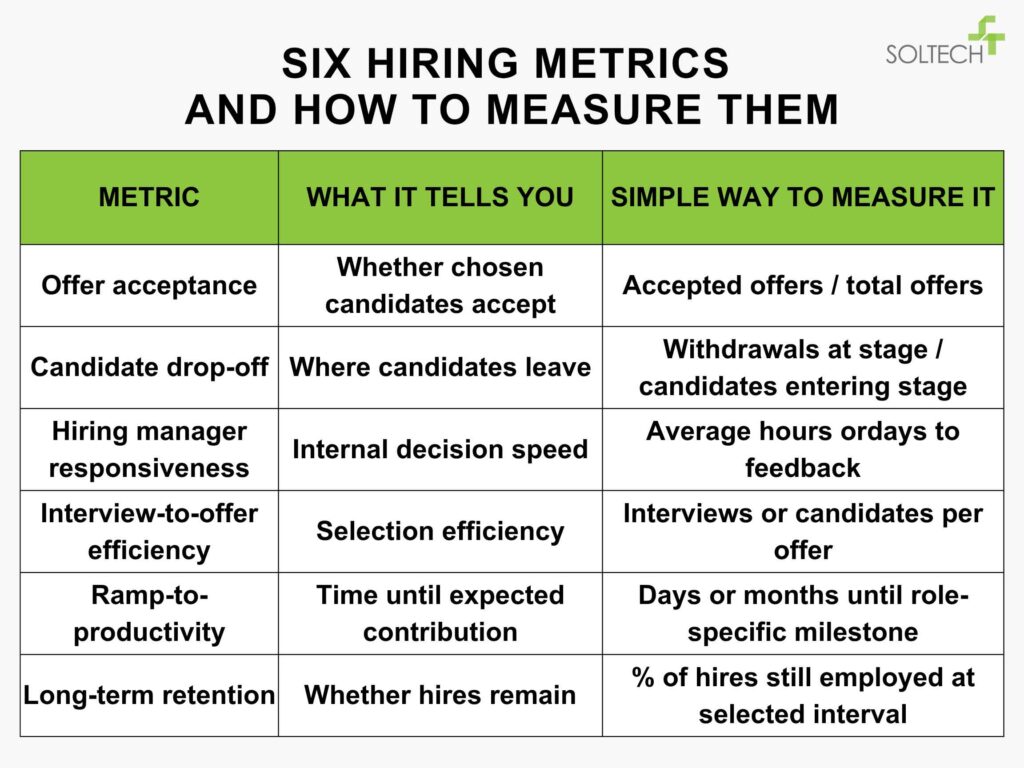
1. Offer Acceptance Rate
Offer acceptance rate measures the percentage of employment offers candidates accept.
A declining rate does not automatically point to one problem. Compensation may be a factor, but candidates may also be responding to the role, flexibility, communication, interview experience, speed of the process, or another opportunity.
Look at the rate alongside documented reasons for declined offers, then compare trends by role, department, level, and hiring period. Patterns are often more informative than a single percentage.
2. Candidate Drop-Off Rate
Candidate drop-off measures where applicants or candidates voluntarily leave the hiring process.
Some withdrawal is normal. People accept other jobs, reconsider a move, or realize that a position is not the right fit. The more useful question is whether candidates are consistently leaving at the same point.
For example, if candidates remain engaged through an initial interview but frequently withdraw during a lengthy assessment, consider whether the assessment provides enough decision-making value to justify what candidates are being asked to invest.
Good recruiting analytics should create better questions, not simply more numbers.
3. Hiring Manager Responsiveness
Recruiting is a shared business process. Recruiters can identify strong candidates and maintain communication, but hiring managers often determine how quickly interview feedback, approvals, and final decisions move forward.
Organizations can measure the average time hiring managers take to submit interview feedback, approve candidates for the next stage, or make a final decision.
I have seen throughout my career how much clarity and communication matter in hiring. When recruiters and hiring managers understand expectations and respond consistently, candidates experience a process that feels intentional, while teams gain better visibility into where decisions are slowing down.
This is not about assigning blame. It is about understanding the process well enough to improve it together.
4. Interview-to-Offer Efficiency
How many interviews does it take to reach a confident hiring decision?
Interview-to-offer efficiency can be examined through the percentage of interviewed candidates who receive offers, the number of candidates interviewed per offer, or the number of interview stages required before a decision.
If a team interviews many people but rarely advances anyone, that pattern could point to unclear role requirements, sourcing misalignment, inconsistent evaluation criteria, or a disconnect between recruiters and hiring managers.
Newer recruiting methods, including skills-based assessments and appropriately governed AI-assisted tools, may also change how candidates are screened and evaluated. Technology has changed the process, but not the purpose of hiring. We are still trying to understand whether someone has the skills, potential, and alignment to succeed.
5. Ramp-to-Productivity
Hiring creates business value as a new employee becomes effective in the role. Ramp-to-productivity helps organizations understand how long that transition takes.
The definition should vary by job. A salesperson might reach productivity after achieving defined pipeline or revenue milestones, while a software developer might be measured against role-appropriate delivery expectations. Other positions may require a combination of competency milestones, manager assessment, and performance objectives.
This metric can also connect recruiting with onboarding. If employees who appeared equally qualified during hiring reach productivity at very different rates, there may be useful lessons about candidate evaluation, role expectations, onboarding, or post-hire support.
6. Long-Term Retention
Retention extends the measurement window beyond the first weeks or months of employment.
HR leaders can examine retention among new hires at meaningful intervals, such as six months, one year, or another period appropriate to the role. A departure does not automatically mean recruiting failed because many factors influence retention.
Over time, however, patterns can be valuable. If hires from a particular recruiting approach, source, skill profile, or candidate pool consistently stay and perform well, that information can help shape a future talent strategy.

How Can I Effectively Measure Recruitment Success?
The most effective approach is to connect recruiting activity with both process health and business outcomes.
Balance Leading and Lagging Hiring Indicators
Candidate drop-off, hiring manager responsiveness, and interview-to-offer efficiency can reveal friction while recruiting is underway. Ramp-to-productivity and retention provide a longer-term view of what happened after the recruiting process ended.
Looking at both creates a fuller picture. Time-to-fill might show that a position took longer than expected to close, while candidate drop-off can help reveal where friction occurred. Offer acceptance shows whether the preferred candidate said yes, and post-hire metrics eventually show more about the outcome.
Measure Trends, Not Just Individual Numbers
A single KPI rarely provides enough context to make a good decision. Look at trends over time and compare similar roles, teams, or hiring channels where appropriate.
A smaller set of measures that leaders understand, discuss, and act on is often more useful than a dashboard filled with numbers that rarely influence decisions.
Can Recruitment Strategies Vary Across Different Industries?
Absolutely. A high-volume employer hiring hundreds of similar positions has a very different recruiting challenge from a company searching for a specialized cloud architect, cybersecurity professional, or technology leader. Sourcing channels, hiring timelines, assessments, interview structures, and definitions of success may all differ.
Define Success for the Role Before Choosing the Metric
This is why external benchmarks need context. A healthcare organization, professional services firm, manufacturer, retailer, and technology company may define productivity differently. Even within the same company, an entry-level customer service role and a senior software engineering role should not necessarily be evaluated against identical recruiting benchmarks.
Start with the business question, then choose the metric. Are candidates withdrawing? Are managers making timely decisions? Are interviews identifying the right skills? Are new hires succeeding after six months?
That approach makes recruiting analytics a leadership tool rather than simply an HR reporting function.
How Can Recruitment Agencies Improve or Help Measure Hiring Outcomes?
Recruitment agencies can extend sourcing reach, bring specialized market knowledge, and provide recruiting capacity when internal teams need additional support. But their value can also be evaluated through many of the same outcomes an organization is already measuring.
An external recruiting partner may be able to influence or help diagnose candidate drop-off, interview-to-offer efficiency, offer acceptance, and hiring manager responsiveness. Post-hire measures such as retention can also provide useful context over time, although attribution should be handled carefully because many factors after the hiring decision influence whether an employee stays.
Connect Recruiting Partnership to the Hiring Funnel
Candidate drop-off is one useful example. A recruiting partner who stays close to candidates throughout the process may hear that an assessment feels overly burdensome, communication has slowed, or expectations about the role have changed. Those observations can add context to the numbers an internal dashboard is already showing.
Interview-to-offer efficiency can reveal something different. If many candidates are reaching interviews but few receive offers, the recruiting partner and hiring team can examine whether the role requirements, sourcing criteria, or interview expectations are sufficiently aligned.
Offer acceptance provides another useful signal. When candidates decline offers, a recruiting partner may be able to surface recurring feedback about compensation, flexibility, responsibilities, timing, or competing opportunities. That does not mean the partner controls the acceptance rate. It means the organization has another source of market insight for understanding it.
Hiring manager responsiveness can also become more visible when an external partner is involved. Clear expectations around feedback and next steps help recruiters maintain candidate communication and keep the process moving.
Look Beyond Resume Delivery
An effective talent acquisition partner should contribute more than a stream of resumes. A strong recruiting partner can help an organization clarify role requirements, understand candidate availability, identify relevant skills, recognize market feedback, and maintain momentum throughout the search.
I’ve found that this partnership is especially important in technology recruiting. Understanding the technical requirement is one part of the work. Understanding the team, business objectives, communication expectations, and what will make someone successful over time is equally important.
The same principle applies to measurement. The goal is not to give an outside partner credit for every positive outcome or responsibility for every negative one. It is to use the partnership as another source of information that helps the organization understand what is happening throughout the hiring process.
What Should HR Leaders Do With Hiring Metrics?
A practical starting point is to choose a small number of metrics tied to the hiring problem you are trying to solve. Define each metric consistently, establish a baseline, and review trends with recruiters and hiring managers at an appropriate cadence. When a number changes, investigate the conditions behind it before deciding what action to take.
The purpose of measurement is not simply to produce a recruiting scorecard. It is to create enough visibility to make better decisions.
That means asking what each number can teach you.
If candidate drop-off rises, investigate where and why. If hiring manager response times increase, look at workload and expectations. If offer acceptance falls, listen carefully to candidate feedback. If new hires take longer to become productive, consider what recruiting and onboarding data reveal together.
The strongest metrics create shared visibility across recruiting, HR, hiring managers, and business leadership.
They also make improvement more constructive. Instead of saying, “Hiring is taking too long,” leaders can have a more specific conversation about where the process is working, where friction exists, and which changes are most likely to help.

From Hiring Faster to Hiring With Greater Clarity
Time-to-fill still belongs on the recruiting dashboard, but speed alone cannot show whether a hiring process is working well.
Metrics such as offer acceptance, candidate drop-off, hiring manager responsiveness, interview efficiency, ramp-to-productivity, and retention provide different views of the same process. Used together and interpreted in the context of the role, industry, and business objective, they can help leaders identify where hiring is working and where improvement is needed.
The goal is not to track more numbers. It is to choose a small set of measures that lead to better questions, better decisions, and clearer accountability across recruiting, HR, hiring managers, and business leadership.
FAQs
What is the best way to measure quality of hire?
There is no single universal formula for quality of hire. Organizations can combine measures such as job performance, retention, skills match, hiring manager satisfaction, new-hire satisfaction, and time to productivity based on what success means for a particular role and business.
How often should recruiting metrics be reviewed?
The appropriate cadence depends on the metric and hiring volume. Operational measures such as candidate drop-off or hiring manager responsiveness may warrant weekly or monthly review, while retention and ramp-to-productivity naturally require longer measurement periods.
Can recruiting analytics improve the candidate experience?
Yes. Candidate drop-off, response times, offer acceptance, and candidate feedback can help organizations identify areas where greater clarity, better communication, or process changes may improve the experience. The value comes from using those insights to understand patterns rather than treating candidates as numbers.
Should every company use the same recruiting KPIs?
Organizations should choose metrics based on their roles, industry, hiring model, business objectives, and definition of a successful hire. Consistency within the organization is valuable, but a metric is most useful when it answers a meaningful business question.

Veanne Smith
CEO & Co-Founder
Veanne Smith serves as the CEO and co-founder of SOLTECH – Atlanta’s premier software development, technology consulting and IT staffing firm.
Prior to founding SOLTECH, Veanne spent more than 10 years in the technology industry, where she leveraged her software development and project management skills to attain executive leadership responsibilities for a growing national technology consulting firm. She is passionate about building mutually beneficial long-term relationships, growing businesses, and helping people achieve their personal life goals via rewarding employment opportunities.
Outside of SOLTECH, Veanne is considered a thought leader in Atlanta’s IT community. Currently, she serves on the Advisory Board for The College of Computing and Software Engineering at Kennesaw State University. In addition, Veanne helped launch the AxIO Advisory Council, has been a member of Vistage for 20 years, and created Atlanta Business Impact Radio – a podcast that showcases some of Atlanta’s most innovative businesses and technology professionals.
As an influential figure in the technology and IT staffing industry, Veanne consistently produces insightful articles that address both the opportunities and challenges in IT staffing. Through her writing, she offers valuable tips and advice to businesses seeking to hire technical talent, as well as individuals searching for new opportunities.
She holds a degree in Computer Science from Illinois State University.
Search