


Technology Hiring Strategy: Hiring for the Need, Not the Title
The conversation around technology hiring strategies has evolved quickly over the past few years. But in many organizations, the way roles are defined has not evolved at the same pace.
I often see companies struggling to fill positions while also feeling unsure about the type of talent they actually need.
That uncertainty is widespread. A McKinsey survey found that 87% of companies say they are already experiencing a skills gap or expect to in the near future.
The job description reflects a familiar role, but the work itself has changed.
That gap is where many hiring challenges begin.
Today’s market requires a more intentional tech talent strategy. The question is no longer simply “Who should we hire?” It is “What capabilities does our business need right now?”
When hiring managers take the time to examine that question, they often realize something important. They have been looking to fill the role they are used to, not the role the work now requires.
The Roles We’re Used to vs. The Work We Actually Have
Technology teams have changed dramatically. Cloud platforms, automation, AI tools, and product-focused development have reshaped how work gets done.
Many Hiring Frameworks Still Reflect Older Structures
Organizations often continue hiring for familiar roles such as:
- Backend developer
- Front-end developer
- QA tester
- Systems administrator
Those roles still exist, but the boundaries between them are far less rigid than they once were. A modern engineer may write application code, manage infrastructure through automation, and contribute to deployment pipelines in the same week.
Over time, I have learned that a strong technology hiring strategy starts with examining the work itself, not the titles we have historically used.
Instead of asking, “Do we need another developer?” leaders might ask:
- Where are our delivery bottlenecks?
- What capabilities are missing on our team?
- What responsibilities are currently spread too thin?
When HR leaders start with those questions, the right role definition usually becomes clearer.

Why Job Descriptions Often Lag Behind the Work
Technology Roles Are Increasingly Defined by Outcomes Rather than Rigid Job Categories
Modern engineering teams often operate across multiple responsibilities. Developers may contribute to architecture discussions, automation, and deployment pipelines, while infrastructure decisions happen alongside application development.
Because of this shift, traditional job descriptions often fall out of sync with the work itself.
In practice, this creates three common challenges:
1. Role definitions become outdated
Job descriptions reflect how teams operated several years ago, not how modern engineering teams collaborate today.
2. Talent pools become unnecessarily narrow
Highly capable candidates may bring the right capabilities but not the exact title or background listed in the posting.
3. Hiring focuses on labels instead of capabilities
Organizations risk overlooking adaptable professionals who could strengthen the team in meaningful ways.
This is where a thoughtful tech talent strategy becomes important. The goal is not simply to fill a role. It is to ensure the team has the capabilities needed to solve the organization’s most important problems.
Curiosity often reveals more about potential than credentials ever could. Hiring managers who explore how candidates think, adapt, and collaborate often uncover stronger long-term contributors than those who focus only on predefined role labels.
Technology has changed how teams work, but it has not changed the purpose of hiring. The goal is still the same, building teams that can solve meaningful problems together.
Hiring for Capabilities, Not Just Titles
Across many organizations, I see a growing shift toward capability-based hiring.
This approach focuses less on job titles and more on the combination of skills and responsibilities that will strengthen the tech team.
For example, a company may begin a search for a “Senior Developer.” But after stepping back and examining the work, they realize what they actually need is someone who can:
- Strengthen system architecture
- Improve deployment automation
- Mentor junior engineers
- Collaborate closely with product leaders
That role might ultimately resemble a technical lead or platform engineer more than the original job description.
When leaders pause to evaluate the real work ahead, the hiring strategy often becomes much clearer.
How to Structure a Modern Tech Team
One of the most common questions HR managers ask is how to structure a modern tech team. While every organization is different, several patterns consistently appear in high-performing technology groups.
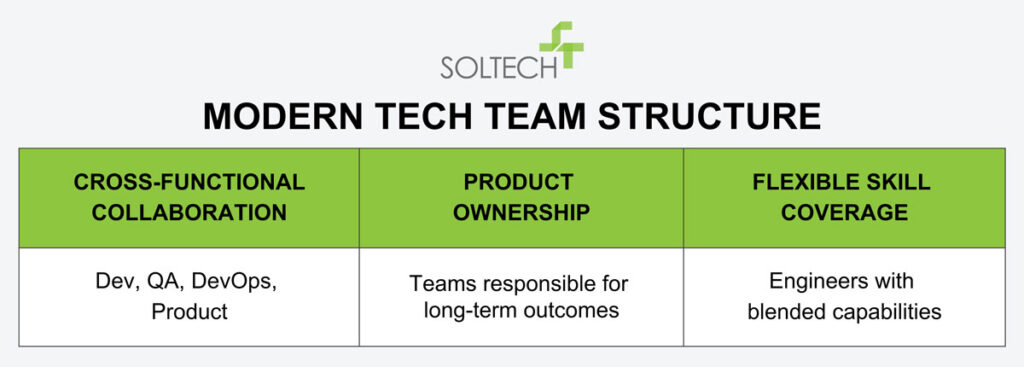
Clarity builds confidence on both sides of the hiring table. When organizations clearly understand how their technology work flows, defining the right role becomes much easier.
A Practical Way to Revisit Your Hiring Approach
When HR leaders revisit their technology hiring strategy, it helps to step back and look at the bigger picture.
3 Questions Often Bring Clarity:
1. What outcomes are we trying to achieve in the next 12 to 18 months?
Growth initiatives, platform modernization, product expansion, or operational improvements will all influence the type of talent needed.
2. Where does work currently slow down?
Delivery bottlenecks often reveal capability gaps more clearly than job titles.
3. What combination of skills would relieve that pressure?
The answer may not resemble the role description the company has historically used.
Sometimes the most valuable hire is not a replacement for an existing role. It is a new capability the team has never had before.
Why Clarity Matters in the Hiring Market Today
The technology hiring market remains competitive, but it has also become more thoughtful.
Candidates are evaluating organizations just as carefully as companies evaluate them. They want to understand how teams collaborate, how decisions are made, and what problems they will be solving.
When companies demonstrate a clear tech talent strategy, candidates gain confidence that the organization has intentionally designed its team rather than simply filling positions.
In my experience, that clarity sends a powerful signal to experienced tech candidates. It shows that leadership understands both the work and the people who make that work possible.
Hiring for the Future, Not the Past
Perhaps the most important shift leaders can make is moving from habit-based hiring to future-focused hiring.
The roles that built yesterday’s systems may not be the roles that build tomorrow’s platforms.
The organizations that thrive are the ones willing to pause, reassess, and ask a simple question:
Are we hiring for the role we need today, or the one we have always hired before?
When leaders answer that question honestly, their technology hiring strategy becomes far more aligned with the work ahead. And that alignment is often what transforms a group of talented individuals into a truly effective technology team.
FAQs
What is the difference between a software developer and a software engineer?
A software developer typically focuses on building and maintaining specific application features or components. A software engineer generally takes a broader view, considering architecture, scalability, and system design across the entire development lifecycle. In practice, the titles can overlap, but “engineer” often reflects a wider technical scope and responsibility.
How do you build the right technology team structure?
Building the right team structure starts with understanding the outcomes your organization wants to achieve. Leaders should evaluate how work flows through their teams, where bottlenecks exist, and which capabilities are missing. When organizations clearly define responsibilities and collaboration patterns, they can better determine how to structure a modern tech team that supports both delivery and long-term growth.
What is skills-based hiring in technology?
Skills-based hiring in technology focuses on evaluating a candidate’s demonstrated capabilities rather than relying primarily on degrees, titles, or years of experience. This approach looks at technical skills, problem-solving ability, and adaptability to new tools or platforms. Many organizations now incorporate skills-based hiring into their tech talent strategy because it helps identify strong candidates who may not fit traditional role expectations but bring valuable expertise to modern engineering teams.

Veanne Smith
CEO & Co-Founder
Veanne Smith serves as the CEO and co-founder of SOLTECH – Atlanta’s premier software development, technology consulting and IT staffing firm.
Prior to founding SOLTECH, Veanne spent more than 10 years in the technology industry, where she leveraged her software development and project management skills to attain executive leadership responsibilities for a growing national technology consulting firm. She is passionate about building mutually beneficial long-term relationships, growing businesses, and helping people achieve their personal life goals via rewarding employment opportunities.
Outside of SOLTECH, Veanne is considered a thought leader in Atlanta’s IT community. Currently, she serves on the Advisory Board for The College of Computing and Software Engineering at Kennesaw State University. In addition, Veanne helped launch the AxIO Advisory Council, has been a member of Vistage for 20 years, and created Atlanta Business Impact Radio – a podcast that showcases some of Atlanta’s most innovative businesses and technology professionals.
As an influential figure in the technology and IT staffing industry, Veanne consistently produces insightful articles that address both the opportunities and challenges in IT staffing. Through her writing, she offers valuable tips and advice to businesses seeking to hire technical talent, as well as individuals searching for new opportunities.
She holds a degree in Computer Science from Illinois State University.
Recent Posts
Search