


How to Create a Software Development Strategy
By Thayer Tate
If you’re a business leader, such as a CEO, CTO, VP of Product, or Director of IT, you’ll know that software is an essential part of success. Even small businesses with 500 or fewer employees typically have around 172 active applications, with an annual expenditure of nearly $8 million. Too often, though, technology decisions are made in silos, disconnected from business outcomes, timelines, and the true cost of execution.
That’s where software and application development strategies come into play.
In this guide, we’ll lay the framework for a clear, executive-level framework to align your software investments with your business goals. Whether you’re modernizing legacy systems, launching a new B2B or B2C platform, or increasing mobile engagement, a strategy-first approach ensures your team uses the right SW development tools and steps to craft the right product.
What is a Software Development Strategy?
In simple terms, a software development strategy is more than just a list of desired product features or a year-long project roadmap. For software teams of all sizes, a well-thought-out application development strategy is often the difference between a successful and fractured project.
This strategy should answer the why, what, and how behind your business’s software strategy. Consider:
- Why am I investing in this project?
- What outcomes do I expect?
- What risks must we manage?
- How will we prioritize, fund, and execute this software development strategy?
Sure, a project roadmap is an essential piece, but it often lacks the context of trade-offs, sequencing, and ownership. Without a defined strategy for your software project, roadmaps simply become wish lists. You’ll want your strategy to:
- Clarify trade-offs to establish which features are in vs. which can be left out.
- Prioritize sequencing to align work with critical business goals and dependencies.
- Tie funding to value to properly allocate resources based on ROI instead of requests.
- Reduce risk by surfacing assumptions and testing them early.
By keeping your internal teams aligned throughout the project, a comprehensive software development strategy ensures your project stays focused on what matters most.
Defining Business Outcomes, KPIs, and Timeframes
One of the most critical aspects of software development strategies is clarity. Ask yourself what outcomes you’re looking to achieve by investing in your organization’s new software.
Whether you’re launching a new product or modernizing critical infrastructure, your technology investments should support some or all of these four categories of software business strategies:
- Revenue Growth: This can be accomplished by adding new channels or faster conversions.
- Cost Savings: New SW development tools can help you boost efficiency and automate your process.
- Risk Mitigation: Ensure your team remains compliant and keeps critical data protected.
- Customer Experience: Focus on usability, speed, NPS, and other key factors of user experience.
So, how can you, as a business leader, efficiently follow the above guidelines? One-line checklists are a common tactic.
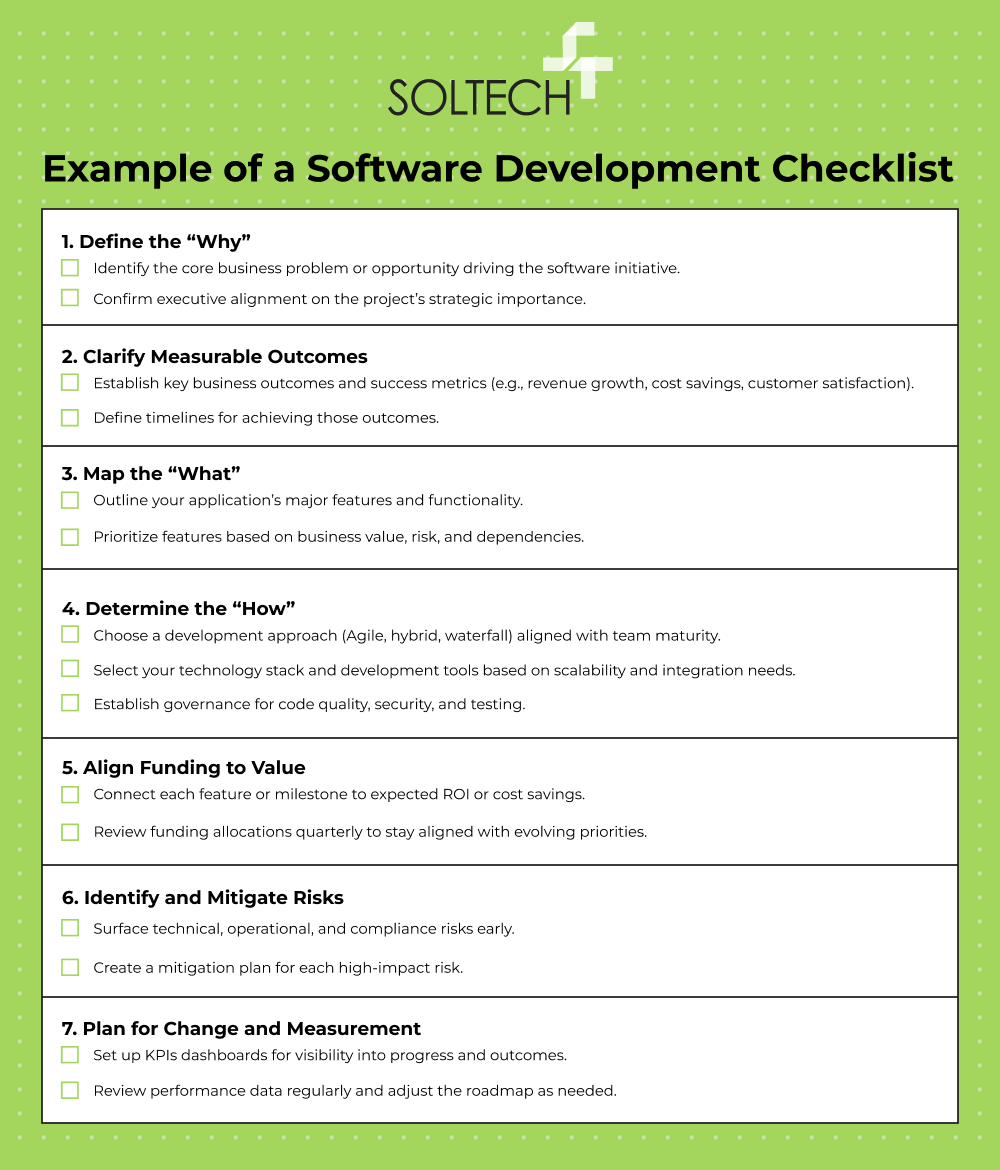
This structured approach to software development strategies ensures that every feature, sprint, or release ties back to a clear business benefit, making it easier for key stakeholders to track progress and course-correct when needed.
Current State Assessment & Portfolio Triage
The next step in developing your software development strategy is to consider what your organization is already working with. This can help you identify what SW development tools or processes are holding your team back.
Because a well-executed strategy requires a clear view of your current software landscape, be sure to take inventory of all applications, platforms, and in-flight initiatives and organize them into four buckets:
- Run: Critical systems required for day-to-day operations. These need stability and ongoing support.
- Optimize: Tools or processes that work but could be improved with automation, performance upgrades, or UX enhancements.
- Modernize: Legacy systems that are still essential but limit your ability to scale, integrate, or innovate.
- Innovate: Net-new initiatives that create new value, markets, or customer experiences.
Once your portfolio is established, then evaluate each system to identify any existing constraints:
- Developer Talent: Do you have the internal expertise to maintain or evolve your organization’s new software?
- Data Quality: Can the system produce reliable, useful insights for you to leverage over time?
- Compliance & Security: Does this new SW development tool or application meet the current regulations?
- Tech Debt: Is the new software stable, scalable, and documented?
- User Impact: How visible or critical is this system to your users?
Once you have all this in order, you can more easily decide what to pause, fix, modernize, or even get rid of, crafting a well-rounded software architecture. And by saving you and your team’s time, your software development strategy can help you focus more of your energy on growing your business.
How to Go From the Application Development Strategy to a Full Scope
As we know, any software development strategy without a scope is simply a product wish list. So, how can business leaders tackle this? To drive the best results for today’s evolving industries, your strategy must translate high-level goals into clearly defined, executable workstreams.
Start by grouping your priorities into large bodies of work tied to a specific business outcome. Then define supporting workstreams, milestones, and success criteria for each. This becomes your tactical roadmap, helping teams understand what’s being built, why, and how success will be measured.
Here are common things to include in every software development strategy scope:
- Objectives: What business goals will the project address?
- In vs. Out of Scope: What will (and won’t) be delivered? Define these important boundaries early.
- Acceptance Criteria: What conditions must be met for this work to be considered complete and successful?
- Dependencies & Risk: What internal or external factors could affect the timeline or progress of the project?
- Change Controls: How will changes to the scope be managed or approved by your internal team?
A pro tip from SOLTECH’s software development experts? Don’t fall into the trap of “overscoping” early in a project. This helps your team avoid burnout and frustrations. Instead, scope in increments, such as 6-week delivery cycles, to leave room for adaptation as SW development tools change or stakeholders want to modify the project.
How to Choose the Right Partner for Your Next Software Development Strategy
Once your goals, priorities, and scope are established, the next step is to decide how you’ll execute. Many businesses choose to partner with a software development consultant such as SOLTECH.
The right operating model can make or break your ability to deliver on time, on budget, and at quality. That’s why your software development strategy should include a clear framework for choosing the right partner setup, whether you’re augmenting your internal team or outsourcing entire initiatives.
A big part of this decision is onshore vs. offshore vs. hybrid setups. While each has its benefits, we recommend onshore, as this strategy allows you to keep in constant, face-to-face communication with your development team.
- Onshore: U.S.-based teams working within your time zone and cultural context. Best for high-collaboration, IP-sensitive projects with complex requirements.
- Offshore: International teams offering lower hourly rates but often introducing communication, time-zone, and quality control challenges.
- Hybrid: Combines offshore development with U.S.-based project management or architecture. Can work for well-scoped, lower-risk tasks but requires strong internal coordination.
When deciding which route to follow, keep in mind these factors:
- Collaboration: If you prefer to collaborate with software developers free of language or cultural barriers, onshore is the way to go.
- IP and Data Sensitivity: A major benefit of onshore labor is that it helps business leaders avoid IP and data risks associated with some international countries.
- Speed to Value: Onshore teams may deliver faster despite higher hourly costs, thanks to tighter feedback loops.
- Compliance Requirements: Some industries restrict how and where data can be handled. It’s important to familiarize yourself with these before executing on any software development strategy.
- Internal Capacity: Finally, does your internal team have the bandwidth to complete your project? If not, partner with a firm like SOLTECH that can help you hire qualified candidates to complete your project.
At SOLTECH, we deliver onshore project teams and staff augmentation services built around your specific needs. No matter your model, alignment matters more than geography. It’s important to choose a partner that will take the time to learn your business and its unique goals.
Creating Pathways to Your Application
Your software development strategy should also account for who you’re building it for. For example, if you create a B2C app that feels too much like a B2B platform, it may be difficult to build a consistent user base.
So, how do you plan for this? Across all major application types, including B2C, B2B, and employee, strong planning includes:
- Defined Roles & Permissions: Who can do what on your platform? And where?
- Mapped Workflows: What are the ideal actions being taken? In what order should they occur?
- Integration Requirements: Which systems do your SW development tools need to connect to?
- KPIs & Benchmarks: What defines success on your new platform, and how will you measure it?
Another consideration business leaders should keep in mind? When and why to go mobile. While it won’t be required for every software application you develop, mobile engagement can help with reach, retention, and even metrics. To succeed with mobile as part of your software development strategy, focus on creating personalized onboarding and platform experiences that leave users wanting more.
If you have a software idea you’d like to bring to life, contact SOLTECH today to set up a consultation. With decades of experience helping organizations like yours gain competitive advantages through technology, we’re here to help you transform plans into results.
FAQs
What is a strategy in software development?
A software development strategy is a high-level plan that connects your business objectives with your software investments. It helps align teams around clear priorities, funding, timelines, and execution models, ensuring that your technology decisions support outcomes such as revenue growth.
How do I develop a software development strategy?
Start by defining your top business goals and identifying key metrics and timelines. Next, assess your current systems, classify them by priority, and identify constraints. From there, you can scope initiatives, choose the right delivery model, and establish reporting.
Why is a strategy important in software development?
Without a strategy, software projects risk becoming unfocused, over-budget, or misaligned with business goals. A well-crafted strategy ensures resources are allocated based on value, not just urgency.

Thayer Tate
Chief Technology Officer Thayer is the Chief Technology Officer at SOLTECH, bringing over 20 years of experience in technology and consulting to his role. Throughout his career, Thayer has focused on successfully implementing and delivering projects of all sizes. He began his journey in the technology industry with renowned consulting firms like PricewaterhouseCoopers and IBM, where he gained valuable insights into handling complex challenges faced by large enterprises and developed detailed implementation methodologies.
Thayer’s expertise expanded as he obtained his Project Management Professional (PMP) certification and joined SOLTECH, an Atlanta-based technology firm specializing in custom software development, Technology Consulting and IT staffing. During his tenure at SOLTECH, Thayer honed his skills by managing the design and development of numerous projects, eventually assuming executive responsibility for leading the technical direction of SOLTECH’s software solutions.
As a thought leader and industry expert, Thayer writes articles on technology strategy and planning, software development, project implementation, and technology integration. Thayer’s aim is to empower readers with practical insights and actionable advice based on his extensive experience.
Search