


Automation vs AI: Why Intelligent Process Automation Solutions Work Better Together
By Thayer Tate
Automation and AI are often discussed as if they are interchangeable. In practice, they serve different roles within a well-designed enterprise system. Intelligent process automation solutions represent the intentional integration of rule-based automation and AI-driven capabilities within business workflows. Intelligent automation, more broadly, blends deterministic systems with learning-based models to improve how work gets done.
This is not a trend discussion. It is an architectural one. The question is not whether automation or AI is more advanced. The question is how to align each capability to the type of problem you are solving.
Automation and AI: Two Distinct Capabilities
Automation: Deterministic by Design
Automation is rule-based. When a defined condition is met, a predefined action occurs. The same input produces the same output every time.
That predictability makes automation well suited for structured, repeatable processes such as:
- Data normalization across systems
- Financial calculations and projections
- Workflow routing and approvals
- Compliance validation and reporting
In these environments, variability is not helpful. Consistency is. Automation creates operational stability, reduces manual effort, and ensures business logic is applied uniformly at scale.
When the process is clear and the inputs are structured, automation is not just sufficient. It is optimal.
AI: Adaptive and Interpretive
AI operates differently. It is data-driven and inference-based. Rather than executing predefined logic, it evaluates patterns and generates outputs based on probability.
AI is particularly valuable when handling:
- Unstructured text
- Document interpretation
- Classification problems
- Ambiguous or incomplete inputs
Unlike automation, AI outputs can vary. Results are often accompanied by confidence scores, and in enterprise settings, thresholds or human oversight may be required. There are also cost implications, since many AI services operate on usage-based pricing models.
Where automation delivers certainty, AI delivers adaptability. It extends capability in areas where rule-based logic becomes impractical or overly complex.
Why the Distinction Matters
Understanding this difference is not theoretical. It directly affects cost, governance, and system design.
Automation provides auditability and predictability. AI introduces probabilistic behavior. Deterministic tasks such as calculations, projections, or rule-based validation rarely benefit from AI. Applying AI in those cases can increase costs without improving outcomes.
This architectural discipline becomes more important as organizations pursue broader intelligent automation strategies. Gartner reports that fewer than 20 percent of organizations have mastered the measurement of hyperautomation initiatives. That statistic suggests many organizations are deploying automation and AI tools without clearly defining how success should be measured across workflows.
When systems are not designed with explicit performance metrics, governance controls, and defined roles for deterministic versus probabilistic components, outcomes become difficult to evaluate. The result is experimentation without alignment.
Where AI Creates Measurable Value
AI becomes valuable when interpretation is required.
Consider contact segmentation. Job titles vary widely across industries and organizations. One company may use “VP of People,” another “Chief Talent Officer,” and another “Director of Human Capital.” Attempting to build rule-based logic to classify every variation quickly becomes brittle and difficult to maintain.
In this scenario, AI can evaluate context and infer role categories effectively.
In a well-designed workflow, the architecture typically looks like this:
- Automation ingests and validates contact data.
- AI performs classification based on title and contextual signals.
- A confidence score is generated.
- Automation resumes to route the contact into the appropriate system or campaign.
This is how modern intelligent automation software is structured. Automation manages structured components. AI is invoked selectively where judgment is required. Once ambiguity is resolved, deterministic processing continues.
The value is not in replacing automation with AI. The value is in orchestrating both.
When to Use Automation vs When to Use AI
Executives benefit from a practical decision framework.
Use Automation When:
- Inputs are structured and predictable.
- Rules can be clearly defined.
- The output must be consistent and auditable.
- Cost control and compliance are priorities.
In these cases, the benefits of intelligent process automation are clear: stability, scalability, efficiency, and governance. Automation reduces variability and supports operational control as volume increases.
Use AI When:
- Inputs are unstructured or ambiguous.
- Interpretation or classification is required.
- Rule maintenance would become complex and fragile.
- Learning over time improves performance.
Market behavior reinforces this blended model. Salesforce research shows that a strong majority of small and mid-sized businesses are actively adopting or experimenting with AI, and those organizations report measurable operational improvements. AI is increasingly embedded within workflows rather than deployed as a standalone capability.
Organizations seeing sustained returns are not choosing automation or AI. They are integrating AI where it enhances automation.
The Hybrid Model: Where Intelligent Process Automation Solutions Excel
In practice, enterprise systems rarely rely on one capability alone.
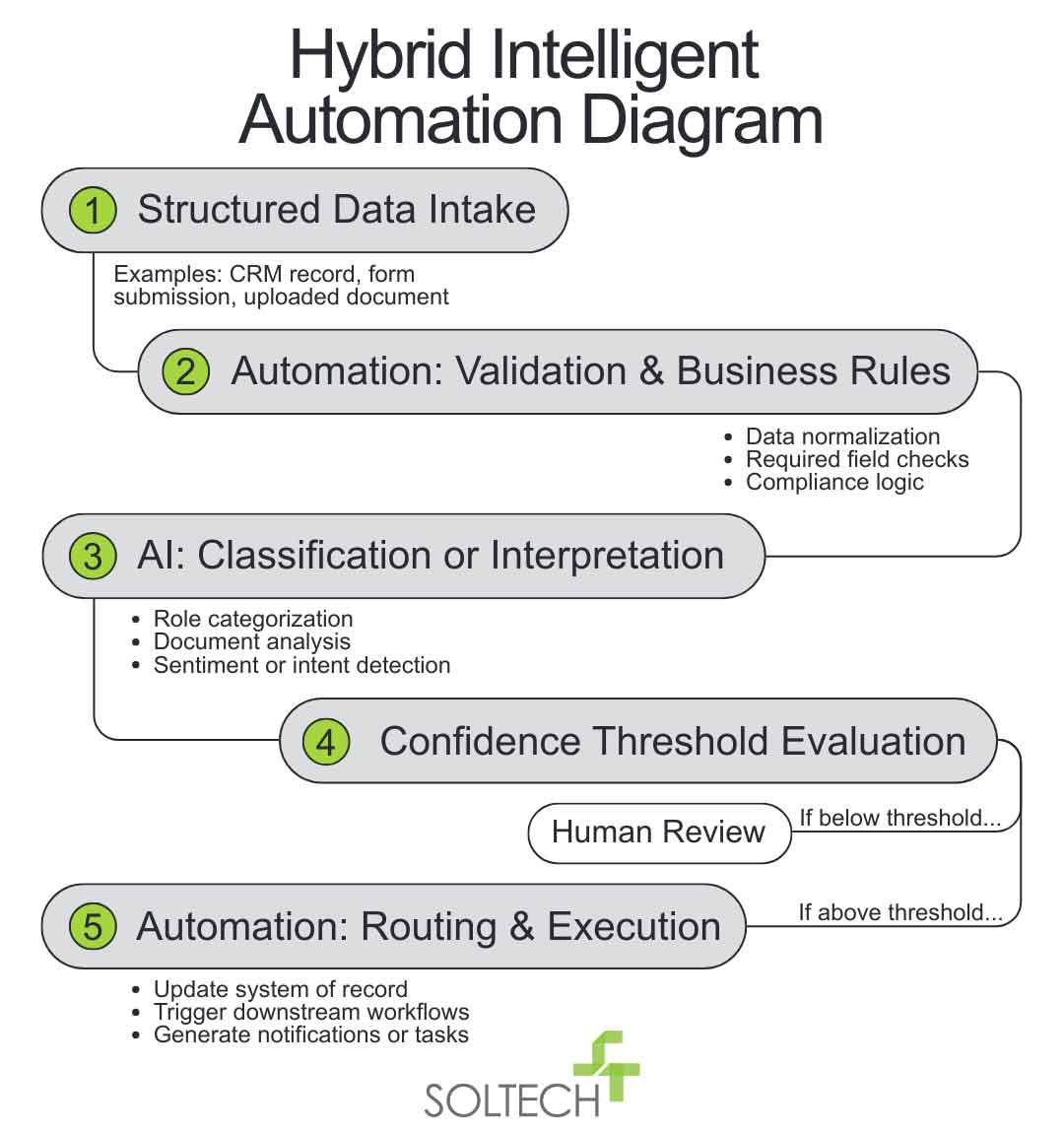
This orchestration defines mature intelligent automation. The strategic advantage lies in workflow design and system architecture, not in selecting a tool labeled “AI.”
When designed intentionally, these hybrid systems reduce manual effort, preserve governance, and introduce adaptability only where it creates measurable value.
How to Choose the Right Approach
Rather than making an enterprise-wide decision in favor of automation or AI, evaluate each use case individually.
Ask:
- Are the inputs predictable?
- Can the rules be clearly articulated?
- Does the task require interpretation?
- What level of certainty is required?
- What is the acceptable cost of variability?
Different processes will require different answers. Financial reconciliation may demand strict determinism. Customer feedback analysis may benefit from adaptive inference.
Hybrid architectures are often the most effective because they reflect the reality that organizations operate across both structured and unstructured domains. Intentional design improves alignment between technology investment and business outcomes.
Design for Alignment, Not Technology Selection
Automation and AI are complementary capabilities. Intelligent process automation solutions represent architectural maturity, not a preference for one technology over another.
The opportunity is not choosing automation or AI. It is aligning deterministic automation and adaptive AI within the same workflow, each applied where it performs best.
When systems are designed intentionally, automation provides consistency and governance, while AI introduces adaptability where interpretation is required. That balance allows organizations to scale with confidence while remaining responsive to complexity.
The real advantage is not found in the tool itself. It is found in how thoughtfully the system is designed.
FAQs
What are intelligent process automation solutions?
Intelligent process automation solutions combine rule-based automation and AI-driven capabilities within structured workflows. Automation handles predictable tasks, while AI addresses interpretation and ambiguity.
What are the benefits of intelligent process automation?
The benefits of intelligent process automation include improved efficiency, scalability, governance, and decision support. By aligning deterministic execution with adaptive intelligence, organizations can increase throughput without sacrificing control.
Is intelligent automation the same as AI?
No. Intelligent automation includes both automation and AI. Automation executes predefined logic, while AI uses data-driven inference to interpret complex inputs. Together, they create a more complete operational architecture.
How do I know if I need intelligent automation software?
You may need intelligent automation software if your workflows involve both structured processes and unstructured inputs. As organizations grow, variability increases. Software that integrates automation and AI allows you to manage that complexity in a controlled, scalable way.
Thayer Tate
Chief Technology Officer Thayer is the Chief Technology Officer at SOLTECH, bringing over 20 years of experience in technology and consulting to his role. Throughout his career, Thayer has focused on successfully implementing and delivering projects of all sizes. He began his journey in the technology industry with renowned consulting firms like PricewaterhouseCoopers and IBM, where he gained valuable insights into handling complex challenges faced by large enterprises and developed detailed implementation methodologies.
Thayer’s expertise expanded as he obtained his Project Management Professional (PMP) certification and joined SOLTECH, an Atlanta-based technology firm specializing in custom software development, Technology Consulting and IT staffing. During his tenure at SOLTECH, Thayer honed his skills by managing the design and development of numerous projects, eventually assuming executive responsibility for leading the technical direction of SOLTECH’s software solutions.
As a thought leader and industry expert, Thayer writes articles on technology strategy and planning, software development, project implementation, and technology integration. Thayer’s aim is to empower readers with practical insights and actionable advice based on his extensive experience.
Search